How to Start Playing Rugby as an Adult in Las Vegas: The Complete 2026 Guide

You've watched a rugby match — maybe at Allegiant Stadium during the NRL's Las Vegas event, maybe on YouTube at 2 a.m. — and something clicked. The speed. The physicality. The fact that every player on the field plays offense and defense. Now you're wondering: can I actually do this?
The answer is yes. Thousands of American adults start playing rugby every year with zero experience. Rugby is one of the fastest-growing sports in the United States, with over 125,000 registered players and youth registrations growing 12% year over year. And right here in Las Vegas, American Pro Rugby (APR) is making it easier than ever for complete beginners to get on the pitch.
This guide covers everything you need to know — what rugby actually is, what gear you need, what it costs, where to play in Las Vegas, and how to survive (and love) your first practice. Whether you're 22 or 52, an ex-football player or someone who hasn't played a sport since high school gym class, this is your roadmap.
Quick Answer: Can You Start Rugby as an Adult with No Experience?
Absolutely. Most adult rugby players in America started after age 18 with no prior rugby experience. All you need is athletic clothes, a willingness to learn, and a local team. In Las Vegas, APR offers five teams welcoming beginners of all fitness levels.
Key Takeaways:
- No experience required — most clubs have beginner-friendly programs and non-contact options
- Startup cost: $100–$200 for basic gear (cleats, mouthguard, shorts); annual club fees typically $400–$500
- Touch rugby is the perfect no-contact entry point if you're not ready for full tackles
- Las Vegas has five APR teams with programs for all ages and skill levels
- The 2031 Rugby World Cup is coming to the USA — now is the best time to get involved
What Is Rugby? A Quick Breakdown for Americans
Think of rugby as what would happen if football, soccer, and basketball had a baby — then took away the helmets, pads, and forward passes. Two teams of 15 players (in rugby union) or 13 players (in rugby league) try to carry, kick, or pass the ball down the field and touch it down in the opponent's in-goal area for a try — rugby's version of a touchdown, worth 5 points.
The catch? You can only pass the ball backwards or sideways. You move forward by running with the ball or kicking it. When you get tackled, play doesn't stop — your teammates form a ruck to win the ball back, and the game keeps flowing. There are no timeouts. No separate offensive and defensive squads. Every player plays both ways for the full 80 minutes.
There's also rugby sevens — a faster version with just 7 players per side and 14-minute games. It's been an Olympic sport since 2016, and it's how many Americans first discover rugby. The U.S. Women's Sevens team won a bronze medal at the 2024 Paris Olympics, and Ilona Maher became the most-followed rugby player in the world on social media.

Rugby vs. Football: The Key Differences
If you played football in high school or college, you already have a huge head start. The tackling fundamentals, spatial awareness, and competitive drive all transfer directly. But there are some important differences you should know:
| Feature | Rugby | American Football |
|---|---|---|
| Players on field | 15 (union) or 7 (sevens) | 11 |
| Game length | 80 minutes (two 40-min halves) | 60 minutes (four 15-min quarters) |
| Pads & helmets | No — optional headgear and mouthguard | Required full pads and helmet |
| Passing | Backward or sideways only | Forward passes allowed |
| Scoring | Try (5 pts), conversion (2), penalty/drop goal (3) | Touchdown (6), extra point (1–2), field goal (3) |
| Play style | Continuous — no stoppages after tackles | Stop-start with play calls between downs |
| Blocking | Not allowed | Core part of the game |
| Roster | Everyone plays offense and defense | Separate offensive/defensive squads |
Interestingly, coaches say basketball players often transition to rugby even better than football players. The constant movement, ball-handling, and "everyone plays both ways" mindset translate perfectly. But truly, rugby is a sport where every body type finds a role — big, small, fast, strong, it all matters.
Why 2026 Is the Best Time to Start Playing Rugby
Rugby in the United States is at an inflection point. The sport has been growing steadily for years, but several things are converging right now that make this the single best time to get involved.
The 2031 Rugby World Cup is coming to America. The United States will host the men's tournament in 2031 and the women's in 2033 — the first time the Americas have ever hosted the men's World Cup. USA Rugby is already investing in grassroots development, school programs, and club infrastructure leading up to the event. Players who start now will have years of experience by the time the world's eyes are on American rugby.
Las Vegas is becoming a rugby city. The NRL has brought professional rugby league to Allegiant Stadium three years running, drawing over 45,000 fans in 2026. That kind of exposure is creating a wave of new interest — and American Pro Rugby is right here ready to channel that excitement into actual playing opportunities.
Non-contact options are exploding. World Rugby has introduced T-1, a non-contact format designed to bring in new players who want the community and fitness without the tackling. Touch rugby leagues are popping up everywhere. You don't have to dive into full contact on day one.
Step-by-Step: How to Start Playing Rugby as an Adult
Step 1: Choose Your Format
Before you show up anywhere, decide what level of contact you're comfortable with. Here are your options:
Touch/Tag Rugby (Zero Contact): Perfect starting point. Two-hand touch replaces tackling. All the running, passing, and strategy — none of the hits. This is how APR recommends most beginners get their feet wet.
Rugby Sevens (Moderate Contact, Faster Pace): Seven players per side, 14-minute games. Less structured than full 15s, more space on the field. Great for athletes who like to run.
Rugby Union 15s (Full Contact, Traditional): The classic format. Fifteen per side, 80 minutes, scrums, lineouts, rucks, and mauls. This is where you'll find the deepest team culture and most structured season.
Step 2: Find a Team in Las Vegas
Las Vegas has a growing rugby scene, and American Pro Rugby operates five teams right here in the city, each with its own identity and community:
🏉 Vegas Kings Rugby — One of APR's flagship squads
🏉 Vegas Knights Rugby — Competitive and community-driven
🏉 Vegas Blackjacks Rugby Club — Built on grit and camaraderie
🏉 Downtown Rugby — Heart of the Las Vegas rugby scene
🏉 Vegas Lions Rugby — Growing fast with a welcoming culture
All five teams welcome complete beginners. APR's mission is to make rugby accessible to every American — whether you're 18 or 55, whether you've played contact sports before or your most intense athletic experience was a company softball game. Reach out to any of the teams above or visit the main APR website to find the right fit.
Step 3: Get Your Gear
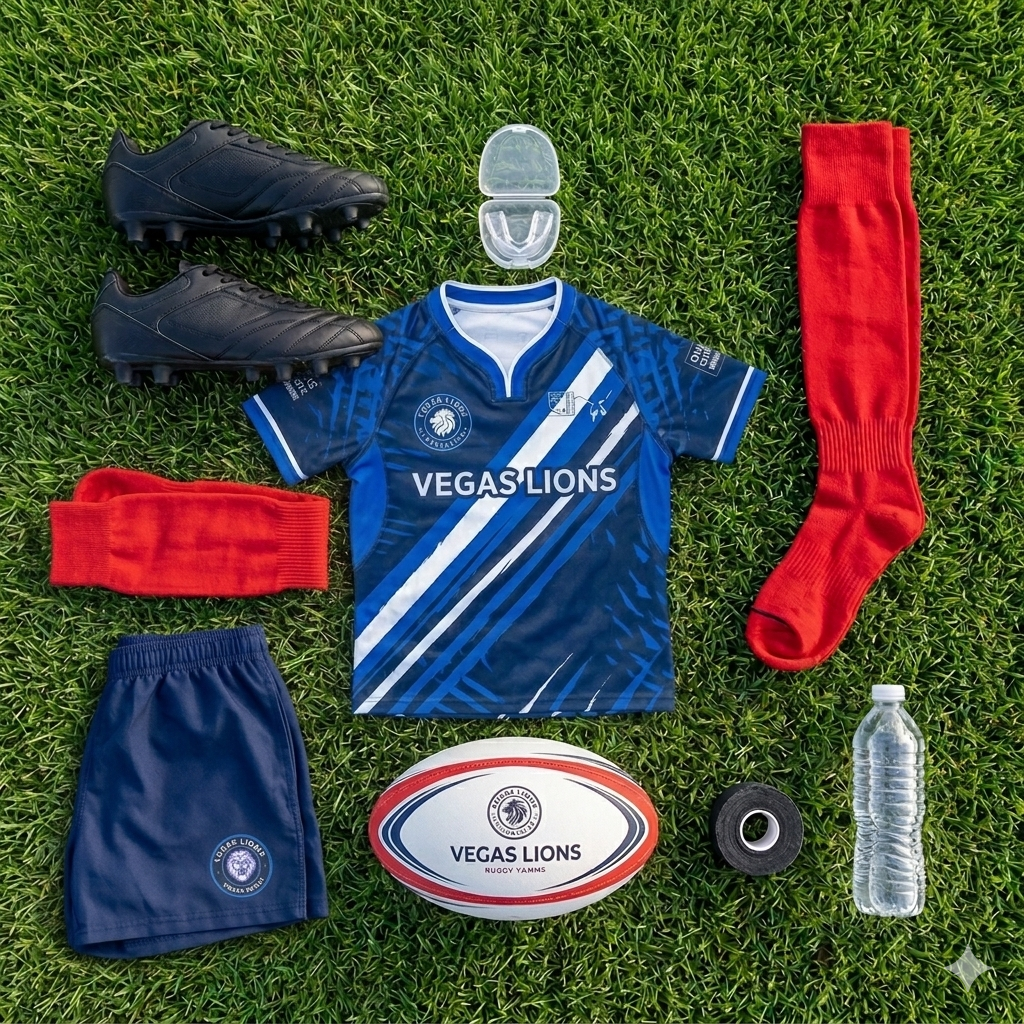
One of rugby's best features: you need very little equipment to get started. For your first practice session, you probably already own everything you need.
For your first session (cost: $0–$20): Athletic shorts without zippers or pockets, a t-shirt you don't mind getting dirty, running shoes or cleats, and water. That's it. Most clubs have spare mouthguards and balls for newcomers.
Once you commit to a season ($100–$200 for gear): Rugby-legal cleats or soccer cleats without a toe stud ($40–$80), a fitted mouthguard ($15–$40), rugby shorts ($20–$30), long rugby socks ($10–$15), and a training jersey. Check out CLANN13 for rugby lifestyle apparel built for the sport.
Optional extras: Lightweight headgear (scrum cap), padded vest for contact confidence, athletic tape, and compression shorts under your rugby shorts. Trust us on that last one.
Step 4: Survive (and Love) Your First Practice
Your first rugby practice will probably include a warm-up jog, basic ball-handling drills (passing while running in a line), some light fitness work, and maybe a game of touch rugby at the end. You won't be thrown into a scrum on day one. Here's what to expect:
You will get things wrong. You'll pass the ball forward. You'll run to the wrong position. Everyone does this. Rugby culture is genuinely one of the most welcoming in sports — experienced players love teaching newcomers.
Cardio is the biggest challenge. Rugby is constant movement. Even experienced athletes from other sports are surprised by the endurance demands. Don't worry about being in perfect shape — just start.
Stay hydrated. Especially in Las Vegas heat. This is non-negotiable. BUAFLOW offers performance hydration designed for athletes pushing through intense sessions — having proper hydration strategy is just as important as knowing the rules.
Step 5: Learn the Basics (Positions, Rules, Lingo)
You don't need to memorize the entire rulebook before your first practice. But understanding the two main groups of players will help you find your spot faster:
Forwards (jerseys 1–8): The bigger, stronger players. They do the scrummaging, lineout work, and heavy-duty tackling. If you played lineman or linebacker in football, this is your group. Positions include props, hooker, locks, flankers, and number 8.
Backs (jerseys 9–15): The faster, more agile players. They do most of the open-field running, passing, and kicking. Think of them as your skill position players — scrumhalf, flyhalf, centers, wings, and fullback. If you played basketball, soccer, or were a running back or receiver, the backs might be your home.
Best position for beginners? Wing or flanker. Wings get involved in open play without needing to know the technicalities of scrums and lineouts. Flankers are essentially "ball hunters" — they tackle, they run, they don't need to be the biggest or fastest person on the field. Your coach will find the right spot for you.

How Much Does It Cost to Play Rugby?
One of rugby's biggest advantages over other sports: it's genuinely affordable. You don't need a $400 helmet, $200 shoulder pads, or a bag full of specialized equipment. Here's a realistic cost breakdown for an adult beginner:
| Item | Cost Range | Notes |
|---|---|---|
| Cleats/boots | $40–$120 | Soccer cleats work fine (remove toe stud) |
| Mouthguard | $15–$40 | Boil-and-bite is fine; custom from dentist ~$100+ |
| Rugby shorts | $20–$35 | No pockets, zippers, or buttons |
| Rugby socks | $10–$15 | Long, over-the-calf style |
| Club membership/dues | $200–$400/season | Covers insurance, pitch rental, coaching, kit |
| USA Rugby registration | $50–$75/year | Required for insured match play |
| Total First-Year Cost | $335–$685 | Gear + season fees — far less than football, hockey, or golf |
Compared to $2,000+ for a season of hockey gear or $500+ for a set of golf clubs, rugby is one of the most affordable team sports you can play. Most clubs also offer payment plans, and your match jersey is typically included with your membership.
How Fit Do I Need to Be to Start?
Here's the honest truth: you don't need to be in great shape to start. You need to be willing to get in better shape. Every rugby club has players of varying fitness levels, and the sport itself will get you fit faster than almost any gym routine.
That said, if you want to give yourself a head start before your first session, focus on three things: running endurance (rugby involves constant jogging with sprints mixed in), bodyweight strength (push-ups, squats, burpees — the up-and-down motion simulates getting tackled and getting back up), and grip strength (you'll be grabbing jerseys, holding onto the ball, and binding in scrums).
A simple pre-rugby fitness plan: run 2–3 miles three times a week, do bodyweight circuits (push-ups, squats, lunges, burpees) twice a week, and work on your passing by throwing a ball against a wall. That's more preparation than 90% of adult beginners do — and they survive just fine.
Why Las Vegas Is the Best City to Start Rugby in America
Las Vegas isn't just where people come to watch rugby — it's becoming where people come to play rugby. Between the NRL bringing international matches to Allegiant Stadium, a growing local rugby community, and American Pro Rugby building a full ecosystem from youth to adult programs, the infrastructure is here.
APR isn't just a single club — it's five teams with distinct identities, connected under one mission: making rugby accessible to every American. Whether you vibe with the Kings, the Knights, the Blackjacks, Downtown Rugby, or the Lions — there's a home for you.

APR also offers youth programs for ages 5–12 and teen programs for 13–18, so if you're a parent who discovers rugby and wants to get your kids involved too, the pathway already exists. The technology behind APR is powered by Vibe Coding, keeping the digital experience as sharp as the on-field action. And the whole community is supported by partners like CLANN13, APR's official apparel and supplements partner — because what you wear and how you fuel matters.
Frequently Asked Questions
How do I start playing rugby with no experience?
Find a local club that welcomes beginners — in Las Vegas, American Pro Rugby has five teams that accept players with zero experience. Show up in athletic clothes and running shoes. Most clubs start newcomers with non-contact drills and touch rugby before progressing to full contact.
Is 30 (or 40 or 50) too old to start playing rugby?
Not at all. Many adult players start in their 30s and 40s. Rugby clubs often have "social" or "veterans" squads for older players, and touch/tag rugby is a fantastic option at any age. APR welcomes players from 5 to 55 and beyond.
How much does it cost to join a rugby club in Las Vegas?
Expect to spend $100–$200 on basic gear (cleats, mouthguard, shorts) and $200–$400 per season on club dues. Total first-year cost is typically $335–$685, making rugby significantly cheaper than football, hockey, or golf.
What equipment do I need for my first rugby practice?
For your very first session: athletic shorts (no pockets or zippers), a t-shirt, running shoes or cleats, and water. That's all you need. The club will have balls and spare mouthguards. You can invest in proper gear once you decide to commit.
Is rugby safe for adult beginners?
Rugby teaches proper tackling technique (using arms and shoulders, never above the shoulders), which reduces injury risk. Dangerous play results in yellow or red cards. Beginners are introduced to contact gradually, and non-contact touch rugby is always an option.
What is touch rugby?
Touch rugby replaces tackling with a two-hand touch. It uses the same basic rules — backward passing, continuous play, try scoring — but without any physical contact. It's a great workout, incredibly social, and the fastest way to learn rugby fundamentals.
What are the five APR teams in Las Vegas?
American Pro Rugby operates the Vegas Kings, Vegas Knights, Vegas Blackjacks Rugby Club, Downtown Rugby, and Vegas Lions. All five teams offer programs for youth (ages 5–12), teens (13–18), and adults (18+) at all skill levels.
How fit do I need to be to play rugby?
You don't need to be in great shape to start — rugby itself will get you fit. If you can jog for 15–20 minutes without stopping, you have enough baseline fitness for your first practice. Focus on building endurance and bodyweight strength as you progress.
What's the difference between rugby union and rugby league?
Rugby union has 15 players per side with contested scrums and lineouts. Rugby league has 13 players with a "play-the-ball" restart after tackles. In the U.S., most club rugby is union. The NRL games at Allegiant Stadium in Las Vegas are rugby league. Both are great — try whichever is available locally.
When is the 2031 Rugby World Cup in the United States?
The men's Rugby World Cup is scheduled for 2031, with the women's tournament in 2033. The U.S. is the first country in the Americas to host the men's event. Host cities haven't been announced yet, but this is expected to supercharge rugby growth across the country.
Ready to Play? Las Vegas Has Five Teams. Find Yours.
Whether you're 18 or 55, whether you've never touched a rugby ball or you played in college and want to get back in the game — American Pro Rugby welcomes you. No experience required. No judgment. Just rugby.
Get training tips, match updates, and exclusive Founding Member access — straight to your inbox.