How Long Is a Rugby Game? Match Length in 15s, 10s and 7s, Explained
Eighty minutes, fourteen minutes, or forty? The answer depends on the format. Here is how long every kind of rugby match lasts, how the clock really works, and why it matters for how you train.
How long is a rugby game? A standard rugby union match lasts 80 minutes of playing time, split into two 40-minute halves with a half-time break of up to 15 minutes. But that is only the 15-a-side answer. A sevens match is 14 minutes, World Rugby's default 10s match is 20 minutes, under-19 rugby is 70 minutes, and the APR Games in Las Vegas plays 10s over two 20-minute halves. And in every format, the clock you see is not the same as the time you spend at the ground.
This explainer walks through the official match length for each format, what "plus time lost" actually means, when a half really ends, how extra time works in knockout games, how sin bins and the newer 20-minute red card fit into the clock, and how long a game takes in real life. Then we turn it into something useful for players: how match length should shape your conditioning, and what a 40-minute 10s game demands of you. If you want the physiology side of the story, our earlier piece on the science behind rugby's 80-minute battle goes deeper on why two 40s became the standard.
- Rugby union (15s): 80 minutes, two 40-minute halves, half-time of up to 15 minutes (World Rugby Law 5).
- Sevens: 14 minutes, two 7-minute halves, half-time of up to 2 minutes; drawn knockout games go to 5-minute golden-point periods.
- 10s: World Rugby's 10s variation sets 20 minutes (two 10-minute halves), but organisers may change it. The APR Games plays two 20-minute halves = 40-minute games.
- Under-19: 70 minutes, two 35-minute halves, no extra time.
- Real time: the clock stops for injuries and reviews and a half only ends when the ball goes dead, so a pro 80-minute match usually takes well over 90 minutes from kickoff to final whistle.
How Long Is a Rugby Game in Each Format?
Rugby union is one sport with several formats, and each has its own clock. World Rugby's Law 5 sets the standard game, and its law variations for sevens, 10s and under-19 rugby replace the timing rules for those formats. Here is the whole picture in one table.
| Format | Players a side | Halves | Total playing time | Half-time | Drawn knockout game |
|---|---|---|---|---|---|
| Rugby union (15s) | 15 | 2 × 40 min | 80 min + time lost | Up to 15 min | Extra time only if the competition allows it |
| Under-19 (World Rugby variation) | 15 | 2 × 35 min | 70 min + time lost | Up to 15 min | No extra time permitted |
| 10s (World Rugby variation) | 10 | 2 × 10 min (organisers may vary) | 20 min + time lost | Up to 2 min | 1-min break, then periods of up to 5 min |
| APR Games 10s (Las Vegas, 2027) | 10 | 2 × 20 min | 40 min | Confirmed with player registration | Confirmed with player registration |
| Sevens | 7 | 2 × 7 min | 14 min + time lost | Up to 2 min | Golden point in 5-min periods |
Two things stand out. First, every format adds "time lost" on top of the listed minutes, which is why the match clock and the wall clock never agree. Second, 10s is the most flexible format on the list. World Rugby's 10s variation gives a default of two 10-minute halves but explicitly says match organisers may vary the duration. The APR Games uses that flexibility to play two 20-minute halves, so every game is a proper 40-minute contest rather than a short sprint. (For more on the format itself, read What Is 10s Rugby?)
15s: the 80-minute game
Law 5.1 says a match lasts no longer than 80 minutes, split into two halves of not more than 40 minutes each, plus time lost. Extra time is only allowed when a match organiser has authorised it for a drawn match in a knockout competition. Law 5.2 caps half-time at 15 minutes, with the exact length set by the match organiser, and lets teams and officials leave the field during the break. Law 5.3 allows organisers of non-international matches to shorten games, which is why some social, college or lower-grade club fixtures play shorter halves. If an organiser doesn't set the length, the teams agree on it, and if they can't agree, the referee decides.
Sevens: 14 minutes of chaos
Sevens halves are seven minutes, with a half-time interval of up to two minutes. Major sevens finals used to run two 10-minute halves, but World Rugby cut them back to seven-minute halves from 2017 after concerns that injuries rose late in those longer deciders. Drawn knockout matches go to golden-point extra time in five-minute periods, so the first score wins. That short, explosive shape is why sevens players train so differently from 15s players, and it's the version that will be played at the LA 2028 Olympics.
10s: the format in between
Tens sits between sevens and 15s on the pitch and on the clock. World Rugby's 10s law variation replaces Law 5.1 with "a match lasts 20 minutes (split into two halves, each of not more than 10 minutes) plus time lost", adds that "match organisers may vary the duration of the match", caps half-time at two minutes, and sets extra time for drawn matches at periods of no more than five minutes after a one-minute break, with teams changing ends without an interval. Tournaments use that freedom differently. At the APR Games 2027, all divisions (Men's Elite and Women's Social) play two 20-minute halves, a 40-minute game. Youth divisions use age-appropriate formats. Full competition rules, including the half-time interval and tie-break procedure, will be confirmed with player registration.
Under-19: 70 minutes
World Rugby's under-19 variation sets 70 minutes, split into two halves of not more than 35 minutes, and states that no extra time is permissible. Younger age grades usually play even shorter games under their national union's age-grade rules, so youth coaches should always check their own league or state union regulations.
What "Plus Time Lost" Means: How the Rugby Clock Works
Rugby's clock is not a countdown that runs no matter what. The referee keeps time (Law 5.4), but can hand that job to the assistant referees or an official timekeeper, signalling every time the clock should stop. In televised professional games you will usually see an official timekeeper and a stadium clock that stops on the referee's signal.
Under Laws 5.5 and 5.6, time can be stopped for:
- Injuries. The referee can stop play for up to a minute so an injured player can be treated, or longer if a seriously injured player needs to be removed from the field.
- Consultations. Time may stop while the referee consults other match officials, including the TMO in games that use one.
- Dead-ball housekeeping. When the ball is dead, time can be allowed for replacing players, fixing or replacing clothing, re-tying a bootlace, or getting the ball back.
Everything else, from scrum resets to kicks at goal, generally happens with the clock running. That is one reason World Rugby has introduced shot clocks. Conversions now have a 60-second limit to match penalty kicks at goal, and scrums and lineouts must be set within 30 seconds. In World Rugby's trials of these changes, ball-in-play time rose by more than two and a half minutes to over 33 minutes a match, while total match time fell by roughly three to five minutes.
When Does a Half Actually End?
This is the bit that confuses newcomers most. When the clock hits 40:00 (or 20:00 at the APR Games), the half does not end on the spot. Under Law 5.7, a half ends when the ball becomes dead after time has expired. That's why you'll see a team in possession keep the ball alive for phase after phase with the clock in red, and why the trailing team often needs to win the ball back rather than just hold on.
There are exceptions where play carries on even after the ball goes dead in overtime:
| Situation after time has expired | What happens |
|---|---|
| A scrum, lineout or restart kick was awarded before time expired | It is completed, and play continues until the ball returns to open play and then goes dead |
| The referee awards a free kick or penalty | Play continues; the team can kick for touch, tap or kick at goal |
| A penalty is kicked directly into touch without being tapped or touched | The half doesn't end; the kicking team gets the lineout |
| A try is scored | Time is allowed for the conversion |
| Play was stopped for player safety | Play restarts with a scrum |
Law 5.8 adds a detail for conversions: the scoring team can attempt the kick or say "no kick" to decline it. If time runs out, the clock is measured from the strike on the ball, so a late try can still be converted.
Extra Time: What Happens When a Rugby Game Is Tied?
Most rugby matches can end in a draw. League and pool games simply record it, and standings use points (for example, Rugby World Cup pool games award four points for a win, two for a draw and bonus points for four or more tries or a loss by seven points or fewer). Extra time is only used in knockout games where a competition's rules call for it.
The details are competition-specific. Recent Rugby World Cup tournament rules, for instance, used two 10-minute periods of extra time, then up to 10 minutes of sudden death where the first score wins, and finally a place-kicking competition from the 22-meter line if teams were still level. Sevens and 10s use short golden-point periods instead. Always check the tournament rules for the event you're playing or watching. For the APR Games, tie-break procedures will be confirmed with player registration.
Sin Bins and the 20-Minute Red Card: Time in the Penalty Box
Cards are part of the clock, too. A yellow card in 15s is a temporary suspension of 10 minutes of match time. In sevens it is two minutes. The suspension runs on match time, not on the wall clock, so stoppages and half-time don't eat into it. World Rugby's guidance gives an example: a player sin-binned at 36:50, with half-time called at 42:36 and the clock reset to 40:00 for the second half, becomes eligible to return at 44:14. Even then, the player can only come back on at a moment when a replacement could be made.
Since 1 July 2025, World Rugby has also run a global law trial for elite rugby of the 20-minute red card. A player sent off for foul play that isn't deemed deliberate is removed for the rest of the match, but after 20 minutes their team can bring on a replacement and return to full strength. Deliberate, highly dangerous foul play still gets a permanent red card. Two yellow cards also count as a 20-minute red card. World Rugby said the trial would be reviewed in 2026, with competitions and unions deciding which elite events apply it. In community rugby, the standard law still applies unless your union says otherwise, so check with your referee society.
For 10s, card lengths are set by the competition. A two-player-down 10s team over 10 minutes is in serious trouble: with fewer defenders across a full-width pitch, every missing player opens space. That's one reason discipline is a real tactical skill in tens.
How Long Does a Rugby Game Take in Real Life?
Here's the practical answer most people want before buying a ticket or blocking out a Saturday.
| Format | Official playing time | Typical time at the ground (approx.) | Why |
|---|---|---|---|
| Professional 15s (Test, MLR, club) | 80 min | About 1 hour 40 minutes to 2 hours, including half-time | Injury stoppages, TMO reviews, kicks at goal and a half-time of up to 15 min |
| Amateur club 15s | Often 80 min, sometimes shorter | About 1.5 to 2 hours | Fewer reviews, but shorter halves and injury breaks vary |
| Sevens match | 14 min | About 20 minutes per game; a tournament day runs many hours | Short games, two-minute half-time, quick changeovers |
| APR Games 10s match | 40 min | Roughly an hour per game, depending on stoppages and the break | Two 20-minute halves plus time lost and half-time |
The "time at the ground" figures are estimates for planning, not rules. Big tests also add warm-ups, anthems and post-match presentations. At the APR Games, the Memorial Day Weekend schedule is built around evening kickoffs: Saturday, May 29 opens with the opening ceremony at 6 PM, an exhibition at 7:30 PM and the social at 9 PM; pool games run Sunday evening; and Monday, May 31 brings the Youth final at 4 PM, the Women's Social final at 6 PM and the Men's Elite final at 8 PM.
And how much of an 80-minute game is the ball actually in play? Less than half. Stats Perform's analysis found ball-in-play time at the 1995 Rugby World Cup was 25 minutes 45 seconds, rising to 34 minutes 18 seconds at Rugby World Cup 2023. That gap between "game time" and "ball-in-play time" is the single most important number for how you should train.
Forty minutes. Ten a side. Under the lights.
The APR Games plays 10s over two 20-minute halves across Men's Elite and Women's Social, with Youth divisions in age-appropriate formats and $15,000 in prize money. Player entry is $299 and includes your official APR Games team jersey, full kit bag, a minimum of three guaranteed pool games, opening-night access and a player profile on americanprorugby.com.
Why Match Length Should Change How You Train
Knowing how long a rugby game is matters most when you plan conditioning. A 15s back-rower, a sevens winger and a 10s player all play "rugby", but the demands are different, because the clock is different.
15s: an 80-minute repeated-effort test
The 15s game is long, with roughly a third or more of it ball-in-play. Players need an aerobic base to recover between efforts, plus the ability to repeat contact, sprint and get back on their feet over and over. Forwards spend more of that time in collisions, scrums, rucks and mauls. Backs cover more distance at high speed.
Sevens: two seven-minute sprints
Sevens is short but brutally intense. With only seven players on a full pitch, there's huge space, long runs and very little rest. Sevens players lean heavily on speed, repeated sprints and the ability to recover in the two-minute half-time and between games on a tournament day.
10s at the APR Games: a 40-minute middle ground
At 40 minutes, a 10s game at the APR Games is half the length of a 15s match but almost three times longer than sevens, with 10 players spread across a full-width field. In practice that means:
- More running per player than 15s. There are fewer bodies to cover the same width, so wingers and back-rowers cover a lot of ground.
- Longer than sevens. You can't simply sprint flat-out for 20 minutes. Pacing and recovery between efforts matter.
- Contact still counts. With five forwards (typically) and contested scrums and lineouts, forwards still need to win collisions and set pieces. Our guide to 10s rugby positions breaks down each role.
- Multiple games across a weekend. Every APR Games entry includes a minimum of three guaranteed pool games, so recovery between games is part of the plan.
A simple way to match training to a 2 × 20 game
This isn't a medical or personal training prescription; work with a qualified coach and build up gradually. But a practical structure many coaches use is to organise conditioning around the length and rhythm of the game you'll actually play:
| Session block | What it looks like | Why it fits 10s |
|---|---|---|
| Game-length blocks | Two 20-minute conditioned games (touch or modified contact) with a short break | Teaches pacing over the real APR Games half length |
| Repeated-effort sets | Short sprint, get down and up, sprint again, then a short walk recovery | Mirrors the sprint–contact–reload pattern of open play |
| Ball-in-play windows | Phases of 60–90 seconds of continuous play, then a "dead ball" rest | Rugby is played in bursts between stoppages |
| Skill under fatigue | Passing and catching at the end of a hard set | Errors happen late in halves; practise the skills tired |
| Tournament recovery | Light day after a match day, sleep, hydration routine | Three or more games across a weekend need recovery between |
If skills are the gap rather than fitness, our new weekly series has you covered. Tuesday Skills #1: the spin pass includes drills you can use as "skill under fatigue" reps, and a new skill drops every Tuesday.
Playing 40 Minutes in Las Vegas: Heat, Hydration and Breaks
Match length and climate go together. Las Vegas in late May is warm, with average highs around 90°F and lows in the mid-60s. That's a big reason the APR Games is built around evening kickoffs under floodlights, rather than midday games.
The laws also allow for heat. Under Law 5.9, in exceptionally hot or humid conditions the referee may allow a two-minute water break in each half, normally around the middle of the half and at a natural stoppage, such as after a score or when the ball is dead near halfway. In extreme conditions, longer breaks and a longer half-time can be allowed under World Rugby's heat guidelines. Whether and how that applies at a given event is up to the match officials and the competition.
For players, the practical lesson is simple: practise your hydration and pre-game routine in training, not for the first time on game day. Many APR players and fans will also want to plan around the schedule. Our partner Luna Appleton publishes guides to where to stay, eat and celebrate in Vegas, and APR partner Clann13 makes supplements for athletes (talk to a qualified professional about what's right for you).

Common Myths About Rugby Game Length
"A rugby game is exactly 80 minutes"
It's 80 minutes of match time plus time lost, and a half only ends when the ball goes dead after time expires. Real games run longer.
"All rugby is 40-minute halves"
Only standard 15s. Under-19 is 35-minute halves, sevens is 7, World Rugby's 10s default is 10, and the APR Games' 10s format is 20.
"The clock stops every time the ball goes out"
No. Unlike American football, the rugby clock generally keeps running through lineouts, scrums and kicks. It stops for injuries, official consultations and certain dead-ball situations at the referee's discretion.
"A sin bin is 10 minutes on the wall clock"
It's 10 minutes of match time in 15s (two minutes in sevens), so stoppages and half-time don't count against it.
"Shorter formats are easier on the body"
Shorter doesn't mean easier. Sevens and 10s spread fewer players across the same width, so running loads per minute are high. They're different, not lighter.
Where to Watch and Play
If you want to see the different clocks in action, the US calendar has plenty: Major League Rugby and Women's Elite Rugby play 80-minute games, and the HSBC SVNS series visits New York in March 2027 for 14-minute sevens. Our guide to pro rugby in the USA lists the leagues and how to watch them, and our rugby news hub covers the latest results.
Want to play 40-minute 10s yourself? The five founding Las Vegas franchises are the place to start. The two clubs pictured in this article are the Vegas Kings and the Vegas Knights, and they're joined by the Vegas Blackjacks, Downtown Rugby and the Vegas Lions, plus one mystery invitational team. Meet them all on the APR teams page. New to the sport? Read how to start playing rugby as an adult in Las Vegas, and see why we think Las Vegas is the perfect home for pro rugby. Clubs building a home ground can talk to APR partner American LED Signage about club and venue signage.
The APR Games is made possible by our partners. Players and fans can support the businesses that support American rugby.
Heading to Vegas for the Coaching Clinic or the Games? Luna Appleton has guides to where to stay and eat. Want the full APR look on and off the field? See the APR merch store.
Frequently Asked Questions
How long is a rugby game?
A standard rugby union match lasts 80 minutes of playing time, in two 40-minute halves, plus time lost for stoppages. Half-time can be up to 15 minutes. Other formats are shorter: sevens is 14 minutes, World Rugby's 10s default is 20 minutes, and under-19 is 70 minutes.
How long is a rugby game in real time?
A professional 80-minute match usually takes roughly 1 hour 40 minutes to 2 hours from kickoff to final whistle, once half-time, injury stoppages, TMO reviews and kicks at goal are included. Amateur games vary.
How long is a 10s rugby game?
World Rugby's 10s law variation sets a default of two 10-minute halves with a half-time of up to two minutes, but it lets match organisers change the length. At the APR Games in Las Vegas, 10s games are two 20-minute halves, a 40-minute game.
How long is a rugby sevens game?
Sevens is two seven-minute halves, 14 minutes in total, with a half-time of up to two minutes. Major finals used to have 10-minute halves but have used seven-minute halves since 2017. Drawn knockout games go to golden-point extra time in five-minute periods.
Why is rugby 80 minutes?
World Rugby Law 5 sets the standard match at no more than 80 minutes, in two halves of up to 40 minutes, plus time lost. It has become the standard length for senior 15-a-side rugby union worldwide. Our article on the science behind rugby's 80-minute battle looks at why two 40s works.
Does the clock stop in rugby?
Sometimes. The referee can stop the clock for injuries, for consultations with other officials such as the TMO, and for some dead-ball situations like replacing players or retrieving the ball. Most other play, including set pieces, happens with the clock running.
What happens when time runs out in rugby?
The half does not end immediately. It ends the next time the ball becomes dead, unless a scrum, lineout, restart, free kick or penalty has been awarded, or a try has been scored and the conversion is still to be taken.
What happens if a rugby game is a draw?
In league and pool games, a draw usually stands and both teams get points. In knockout games, extra time is used only if the competition allows it. Recent Rugby World Cups used two 10-minute periods, then sudden death, then a kicking competition. Sevens and 10s use short golden-point periods.
How long is a yellow card in rugby?
In 15s a yellow card is a 10-minute suspension of match time, and in sevens it is two minutes. Since July 2025 elite rugby has also trialled a 20-minute red card, after which a team can bring on a replacement for a player sent off for non-deliberate foul play.
Are the players in the images real?
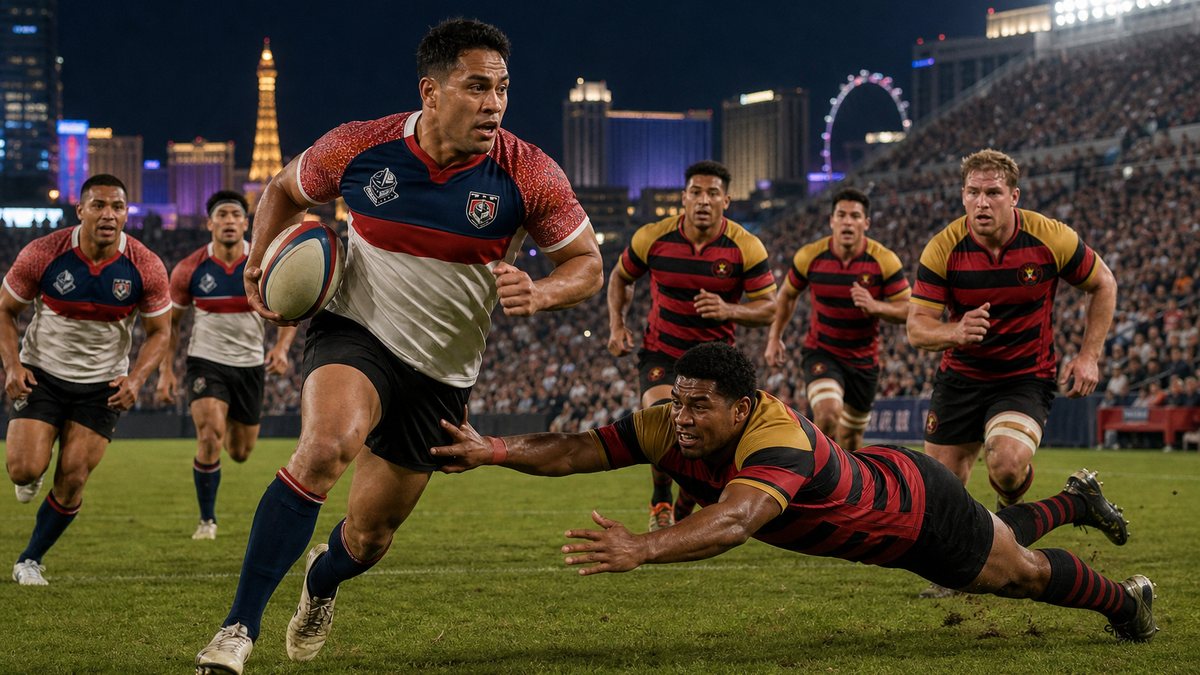
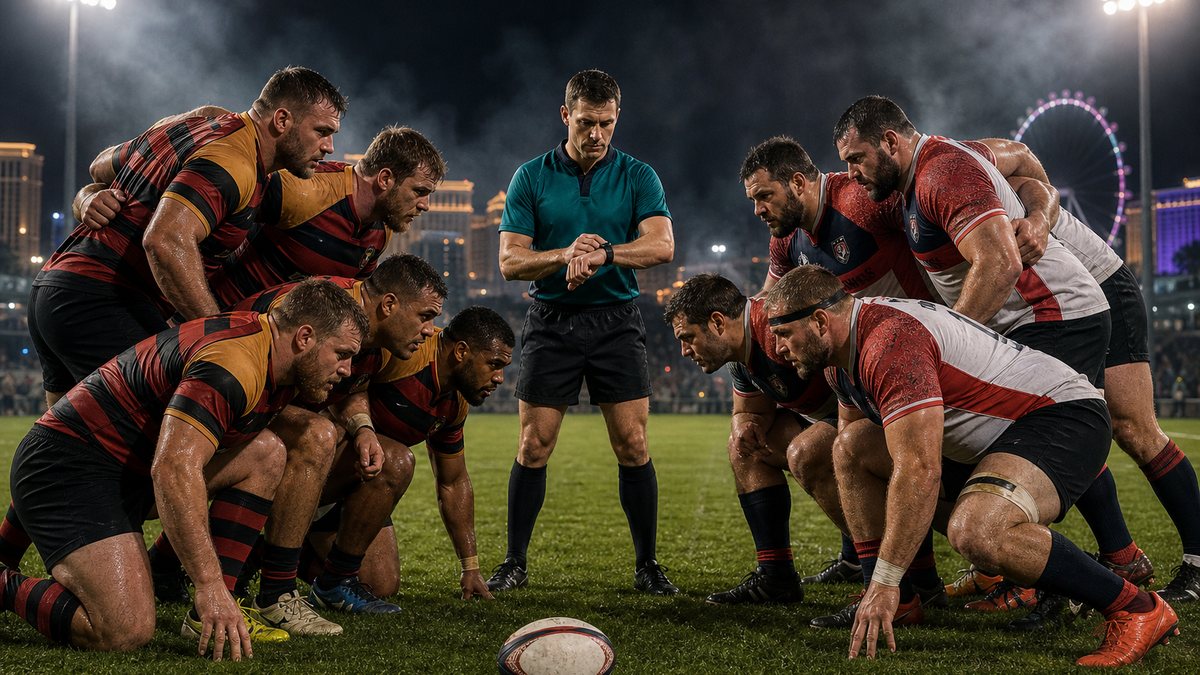
No. The images are illustrations of fictional players wearing the kits of two APR franchises, the Vegas Kings and the Vegas Knights. They do not show a real match or result.
Keep Reading
Don't miss the next one: follow @americanprorugby, sign up to the APR newsletter, or read what the APR Games is all about.
Sources
- World Rugby Laws: Law 5 — Time
- World Rugby Laws: 10s variation — Law 5 Time
- World Rugby Laws: Under-19 variation — Law 5 Time
- World Rugby Passport: Sin bins (yellow card)
- World Rugby Passport: 2025 global law trial — 20-minute red card replacement
- World Rugby: Council moves 20-minute red card to global law trial
- World Rugby: Fan-focused laws move closer to global implementation (shot clocks, trial data)
- Rugby Australia: Big sevens finals cut to seven minutes
- Rugby World Cup: Tournament rules (knockout extra time and pool points)
- Stats Perform: The evolution of rugby — a statistical analysis
This explainer is for general education and is based on World Rugby's laws and the sources above, current as of October 2026. Competitions can vary match length and card rules; always check your league or tournament regulations. Training suggestions are general and not medical advice. APR Games 2027 competition rules will be confirmed with player registration. Questions? Contact us.