8-Week Rugby Training Plan to Get Fit for 10s Rugby
A week-by-week rugby training plan built for 10-a-side: conditioning for 20-minute halves, strength that survives contact, heat-smart sessions for an evening tournament in Las Vegas, and a taper that gets you to kickoff fresh.
A good rugby training plan does one job: it gets you to the first whistle able to repeat hard efforts for the whole game, strong enough to survive contact, and fresh rather than worn out. This guide gives you a complete 8-week plan built around the demands of 10s rugby, the format played at the APR Games 2027 in Las Vegas on Memorial Day Weekend, May 29–31, 2027.
It is written for adult club players, social players coming back to the game and anyone building a team for a tournament. It is a framework, not a prescription: adjust it to your age, experience, injury history and schedule, and if you have any medical concerns, talk to a doctor or a qualified strength and conditioning coach before you start. We will cover what 10s actually asks of your body, how the eight weeks are structured, the sessions inside each week, how to train for heat, how to recover, and how to taper into a tournament.
- Train for peaks, not averages: 10s is played in short, intense passages. Build an aerobic base, then train repeated hard efforts with short recoveries.
- Three phases: Weeks 1–3 build volume at moderate intensity, weeks 4–6 add intensity and rugby-specific conditioning, weeks 7–8 sharpen and taper.
- Four to five sessions a week: two strength, two conditioning, one team or game-based session, with at least two easy or rest days.
- Warm up properly every time: World Rugby's Activate programme is free and built for exactly this.
- Respect the heat: Las Vegas in late May is hot even in the evening. Acclimatize gradually and drink to a plan.
What 10s Rugby Demands From Your Body
Before you build a plan, be clear about what you are training for. At the APR Games every division plays 10s: 10 players a side, typically five forwards and five backs, over two 20-minute halves, so 40 minutes of rugby per game. If you are new to the format, our explainer on what 10s rugby is covers it in full, and how long a rugby game lasts compares 10s with 15s and 7s.
Ten players on a full-width pitch means more space than in 15s. More space means more running in open play, more line breaks and more scramble defense. But you still have scrums, lineouts, rucks and mauls with five forwards. The result is a hybrid: the open-field running of sevens with more of the contact load of fifteens.
Two pieces of research are useful here, even though neither studied 10s directly:
- Averages hide the hard parts. A study of international rugby union by Pollard and colleagues found that running intensity measured only while the ball is in play is significantly higher than the whole-match average, which includes stoppages. If you train only to match an average pace, you will be underprepared for the passages that decide games.
- Fatigue shows late. In international sevens, Peeters and colleagues (Journal of Sports Science and Medicine, 2019) found a small drop in high-speed distance and accelerations in the second half, and a clear decline after the most intense minute of a game. Short formats reward teams that can still accelerate late.
APR's view: for 10s, the physical quality that matters most is repeated high-intensity effort — sprinting, tackling, getting up and doing it again with little rest — sitting on top of a solid aerobic base, plus enough strength to make every contact safer. That is what this plan builds.
Forwards vs backs in 10s
Everyone needs the same foundation, but the emphasis differs. Forwards spend more time in contact, rucks and set piece, so they need more strength and more work on getting up off the ground and back into the line. Backs cover more ground at high speed, so they need more top-end sprint exposure and more change-of-direction work. Our guide to 10s rugby positions breaks down each role. In the plan below, the "Forwards" and "Backs" notes tell you where to shift the emphasis.
How the 8-Week Plan Is Built
World Rugby's conditioning guidance splits pre-season into a general preparation phase and a specific preparation phase. It notes that players often return deconditioned after the off-season, and that the general phase should be built on high training volume at relatively low intensity, not the other way around, because jumping straight into high-intensity work after a layoff tends to backfire. Our plan follows the same logic across three blocks:
| Block | Weeks | Goal | What it feels like |
|---|---|---|---|
| 1. Build | 1–3 | Aerobic base, movement quality, general strength | Longer sessions, moderate effort, you finish feeling you could do more |
| 2. Develop | 4–6 | Repeated high-intensity efforts, power, rugby-specific conditioning | Shorter, harder intervals; game-like work-to-rest ratios |
| 3. Sharpen & taper | 7–8 | Speed, game sharpness, freshness | Quality over quantity; volume drops, intensity stays high |
Each week has a simple rhythm:
- Strength A (lower-body focus) and Strength B (upper-body and trunk focus).
- Conditioning 1 (aerobic or tempo) and Conditioning 2 (intervals or repeated efforts).
- Team / game session with your club or a few teammates: small-sided games, unit work, attack and defense shape.
- Two lighter days: full rest, an easy walk, mobility or a swim.
If you can only manage three sessions a week, keep both strength sessions and combine the two conditioning sessions into your team session by playing small-sided games with deliberate work and rest periods.
Before you start: a quick baseline
Test yourself in week 1 so you can see progress in week 6. Keep it simple and safe: a timed 1.5-mile or 2.4 km run (or a 6-minute run for distance), a 10 m and 40 m sprint after a full warm-up, and a few bodyweight markers such as push-ups and a plank hold. Write the results down. A field test like this is not a lab measurement, but repeated under the same conditions it tells you whether the plan is working.
The Warm-Up: Do It Every Session
The most underrated part of any rugby training plan is the 15 minutes before it starts. World Rugby's free Activate injury-prevention programme was designed for rugby training sessions and pre-match warm-ups, with levels that progress through the season. World Rugby reports that research shows Activate can reduce the risk of muscle and ligament injuries by 26–40% and the risk of concussion by 29–60%, with better results for players who use it regularly.
A simple structure that fits this plan:
- Raise: 3–4 minutes of easy jogging, side shuffles and backpedals.
- Mobilize: hips, ankles, thoracic spine and shoulders.
- Activate: the Activate exercises for your level (balance, single-leg strength, landing, neck and trunk work).
- Potentiate: 3–4 build-up runs to about 80–90% speed and a few quick changes of direction.
Weeks 1–3: Build the Engine
The goal of the first block is to make you fit enough to train hard later. Most of the conditioning is at a pace where you can speak a few words but not hold a conversation. Strength work uses controlled tempo and full range of motion with weights you could lift for two or three more reps than you do.
| Day | Session | Weeks 1–3 content |
|---|---|---|
| Mon | Strength A (lower) | Squat or goblet squat 3×8 · Romanian deadlift 3×8 · Split squat 3×8 each leg · Calf raises 3×12 · Side plank 3×30 s each side |
| Tue | Conditioning 1 (aerobic) | Week 1: 25 min continuous easy run or bike · Week 2: 30 min · Week 3: 30 min with 6 × 1 min steady surges |
| Wed | Rest / mobility | Walk, stretch, mobility circuit 20 min |
| Thu | Strength B (upper + trunk) | Push-ups or bench press 3×8 · Inverted row or dumbbell row 3×10 · Overhead press 3×8 · Farmer's carry 3×30 m · Neck strengthening (as taught in Activate) |
| Fri | Conditioning 2 (tempo) | Tempo runs on a pitch: run the length at about 70% effort, walk the width back. Week 1: 2 sets of 6 · Week 2: 2×8 · Week 3: 3×6 |
| Sat | Team / game session | Skills warm-up, unit work, then touch or small-sided games in 3-minute blocks with 2 minutes rest |
| Sun | Rest | Full rest |
Forwards: add a set of carries (sled pushes or heavy bag carries) to Strength A in week 3. Backs: finish Conditioning 2 with 4 relaxed strides at 80% to keep speed in your legs.
Progress gradually. A common coaching rule of thumb is to increase total weekly running by modest amounts, not big jumps, and to keep at least one easier week every few weeks. Sore is normal in week 1; sharp pain in a joint is not, and is a reason to stop and get it checked.

Weeks 4–6: Make It Game-Like
Now you have a base, the work gets shorter and harder. The aim is to repeat high-intensity efforts with short, incomplete recoveries, the way a 10s game actually unfolds. Strength work shifts toward power: moving moderate loads fast, plus jumps and throws.
| Day | Session | Weeks 4–6 content |
|---|---|---|
| Mon | Strength A (lower power) | Box jumps or squat jumps 4×4 · Squat 4×5 (heavier, good form) · Single-leg Romanian deadlift 3×6 each · Sled push or hill walk 4×15 m · Pallof press 3×10 each side |
| Tue | Conditioning 1 (intervals) | Week 4: 8 × 30 s hard / 30 s easy · Week 5: 10 × 30/30 · Week 6: 2 sets of 8 × 20 s hard / 20 s easy, 3 min between sets |
| Wed | Rest / mobility | Easy bike or swim 20 min, mobility |
| Thu | Strength B (upper power) | Medicine ball chest pass and rotational throws 4×5 · Bench press or weighted push-up 4×5 · Pull-ups or chin-ups 4×max good reps · Single-arm row 3×8 · Loaded carries 3×30 m |
| Fri | Conditioning 2 (repeated efforts) | "Up-down and go" sets: get down to the ground, up, sprint 20 m, jog back. Week 4: 3 sets of 5 · Week 5: 4×5 · Week 6: 4×6 with 2–3 min between sets |
| Sat | Team / game session | Attack and defense shape against opposition, then 10-a-side conditioned games of 4–6 minutes with 2 minutes rest |
| Sun | Rest | Full rest |
Forwards: in the repeated-effort sets, add a short push on a tackle shield or a ruck-pad drive before each sprint, under a coach's supervision. Backs: add a curved 30 m run or a change of direction into each sprint, and one session a week of 4–6 flying 20 m sprints at full speed with full recovery.
Week 6 is the hardest week of the plan. Repeat your baseline tests at the start of the week, when you are fresh, and compare.
Tactics and systems need fit legs too
Conditioning should not live in a separate box from rugby. In 10s, a defensive line with five or six players across a full-width pitch only works if everyone gets back on their feet and into position quickly. Use your team sessions to rehearse your defensive system and attack shape under fatigue: run a hard set of efforts, then go straight into a 3-minute game where the coach scores how fast the line reforms and whether players communicate. That is where fitness turns into results.
For the individual skills you will use in those games, our weekly Tuesday Skills series has drills and practice plans; the latest episode covers how to catch a rugby ball under pressure. Slot one skills block into each team session.
Training for something? Make it the APR Games.
Put your eight weeks to work at the APR Games on Memorial Day Weekend in Las Vegas. Player entry is $299 and includes an official APR Games team jersey, a full kit bag, a minimum of three guaranteed pool games, opening-night access and a player profile on americanprorugby.com. The APR Coaching Clinic runs May 28–31, 2027.
Weeks 7–8: Sharpen and Taper
The final two weeks are where many players get it wrong, either by cramming in extra fitness or by stopping completely. Neither works. The principle of a taper is to cut the amount of training while keeping some intensity, so fatigue drops and fitness stays.
| Day | Week 7 (sharpen) | Week 8 (taper / tournament week) |
|---|---|---|
| Mon | Strength A: jumps 3×3, squat 3×3 (moderate), single-leg work 2×6 | Strength: short and light, 2 sets of the main lifts, focus on speed |
| Tue | Intervals: 2 sets of 6 × 20 s hard / 20 s easy | Short speed session: 4 × 20 m and 3 × 30 m at high speed, full recovery |
| Wed | Rest / mobility | Rest / mobility |
| Thu | Strength B: throws 3×4, press 3×3, pull 3×5 | Team run-through: shape, set piece, restarts — about 45 minutes, crisp, no extra fitness |
| Fri | Repeated efforts: 3×5 up-down and go | Rest or a 15-minute walk-through; travel, sleep, hydrate |
| Sat | Full-length practice game (2 × 20 min) at the time of day you will play | Tournament |
| Sun | Rest | Tournament |
Play your week 7 practice game in the evening if you can. APR Games kickoffs are under floodlights: Saturday's opening ceremony is at 6 PM, Sunday's pool games are in the evening, and Monday's finals run from 4 PM (Youth) to 8 PM (Men's Elite). Train your routine — meals, warm-up, kit — around those times so tournament day feels familiar.
When to start for May 29, 2027
Count back from the tournament. To finish week 8 on Memorial Day Weekend, start week 1 in the first week of April 2027. If you are coming off a long layoff, spend four to six weeks before that doing two easy runs and two simple strength sessions a week so week 1 is not a shock. If your club season runs through spring, use weeks 4–8 alongside your games and drop Conditioning 2 on match weeks.
Training for Heat: Playing Evening Rugby in Las Vegas
Late May in Las Vegas typically brings average highs around 90°F and lows in the mid-60s. APR Games matches are scheduled for the evening, which helps, but it can still be warm, dry and windy at kickoff, and your body works harder in heat.
World Rugby updated its heat guidelines in 2025. Instead of air temperature alone, they use a Heat Stress Index (HSI) from 0 to 250 that combines air temperature, humidity, wind and radiant heat. At "moderate" readings players are advised to drink more and wear less; at "high" readings each half gets a three-minute cooling break with measures such as iced towels; at "very high" readings half-time is extended to 20 minutes; and at "extreme" readings organizers should consider delaying or suspending play. The Laws of the Game also allow a water break in each half in hot conditions. Final APR tournament rules will be confirmed with player registration.
What that means for your training:
- Acclimatize gradually. In the last two to three weeks, do some easier sessions in warmer conditions, building up the time over several sessions rather than one big hot workout. If you live somewhere cool, extra layers during an easy bike session are a common approach — keep it conservative.
- Have a drinking plan. Start sessions hydrated, drink during breaks and weigh yourself before and after a few sessions to learn how much you lose. Large losses mean you need to drink more next time.
- Know the warning signs. Dizziness, confusion, headache, nausea, stopping sweating or unusual fatigue are reasons to stop, cool down in the shade and get medical help if they don't settle quickly.
- Plan your days in Vegas. Keep tournament days simple: shade, fluids, rest off your feet, and save the Strip for after the final whistle. Our sponsor Luna Appleton has guides to where to stay and eat in Las Vegas, and our Why Las Vegas article explains why evening rugby suits the city.

Recovery, Sleep and Food Basics
You do not get fitter during the session; you get fitter while you recover from it. A few basics matter more than any gadget:
- Sleep: a regular bedtime and enough hours are the cheapest performance tool you have.
- Easy days are easy: if your rest days turn into extra hard sessions, your hard days get worse.
- Eat real meals: regular meals with protein, plenty of carbohydrate around harder training days, fruit and vegetables. If you want individual nutrition advice, see a registered dietitian. Athletes often ask about supplements; APR partner Clann13 makes supplements for athletes, and as with any supplement, check with a qualified professional whether it suits you.
- Listen to warning signs: persistent soreness, poor sleep, low mood or performance getting worse for more than a few days suggest you need more recovery, not more training.
- Concussion: any suspected concussion means stopping and following a graduated return process with medical advice. Never train through concussion symptoms.
Coaching a Team Through the Plan
If you are a coach or captain building a 10s team, the same plan works for a group with a few adjustments:
- Use the team session as the anchor. Most social and club players can make one or two team sessions a week. Make those count with game-based conditioning, and give players the strength and running sessions to do on their own.
- Track simply. A shared spreadsheet or chat where players post what they did is enough. Ask for a 1–10 effort rating after each session; if the team's average effort keeps climbing while performance stalls, ease off.
- Build a deep squad. In a 40-minute game with tournament rounds on consecutive days, fresh legs from the bench matter. Plan rotations in week 7's practice game.
- Get qualified. USA Rugby requires coaches to complete "Rugby's Safety Basics" (World Rugby Rugby Ready and a concussion course), and World Rugby Level 1 is required for coaches who teach tackling. See USA Rugby coaching for the pathway.
- Look after logistics. Team kit, travel and a place for everyone to stay are part of preparation. Clubs setting up properly can look at American LED Signage for club and venue signage.
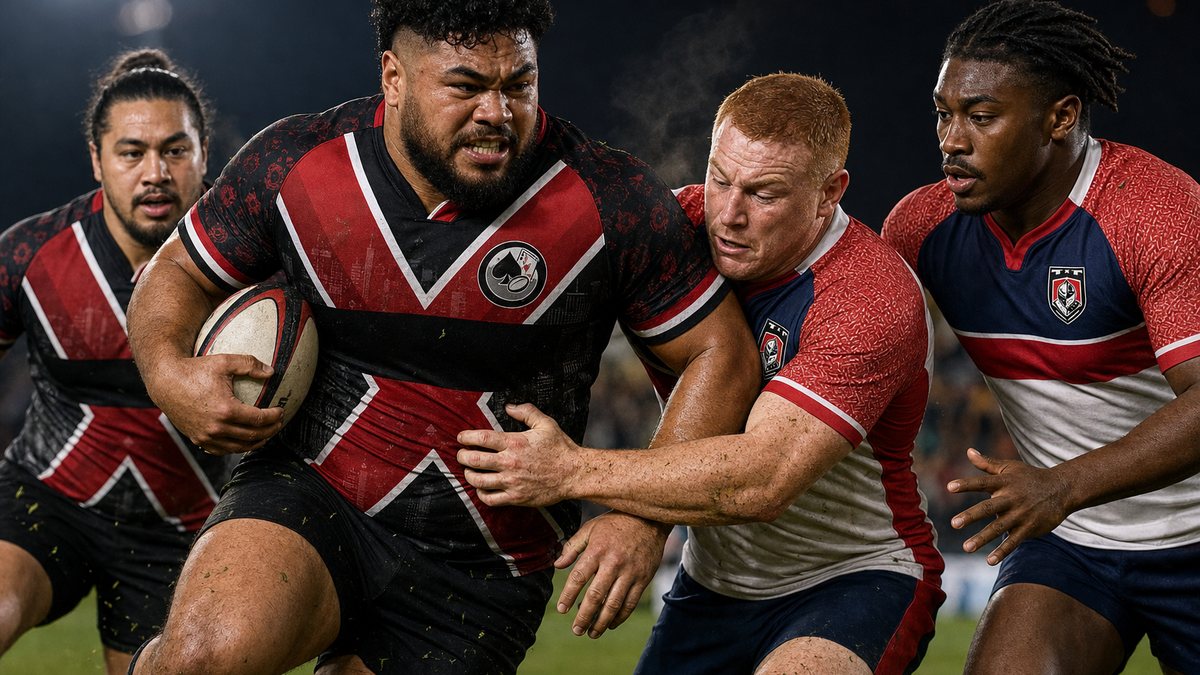
New to all this? Start with our guide on how to start playing rugby as an adult in Las Vegas, and meet the five founding franchises on the APR teams page. The kits in today's illustrations belong to the Vegas Blackjacks, founded in 1976 and known as Las Vegas's oldest sports club, and the Vegas Knights. The other founding sides are the Vegas Kings, Downtown Rugby and the Vegas Lions.
Common Training Plan Mistakes
- Only running long and slow. A base matters, but if all you do is jog, 10s will find you out in the second half. Weeks 4–6 exist for a reason.
- Only doing sprints. The opposite problem: high-intensity work with no base leads to poor recovery between efforts and a higher risk of injury.
- Skipping the warm-up. It is the easiest injury-prevention tool you have.
- Testing your max in week 8. The taper is for freshness. Save the personal bests for the tournament.
- Ignoring heat. Arriving in Las Vegas from a cold climate with no heat exposure and no drinking plan is a common way to have a bad weekend.
- Training through pain. Small niggles caught early cost days. Ignored, they cost the tournament.
The APR Games is made possible by our partners. Players and fans can support the businesses that support American rugby:
Building an app to track your team's training? Vibe Coding explains how people build their own tools with AI. Launching a rugby business? Giftabiz lets friends and family back a new business launch, and In Too Win works with Las Vegas businesses.
Frequently Asked Questions
How long does it take to get fit for rugby?
It depends on your starting point. A player with a reasonable base can be game-fit for 10s in about eight weeks of consistent training. If you are coming back from a long break, add four to six weeks of easier running and basic strength work first.
How many times a week should I train for rugby?
Four to five sessions a week works for most adult players: two strength sessions, two conditioning sessions and one team or game-based session, with at least two easier or rest days. Three well-planned sessions is still effective if that is all you have time for.
What kind of fitness does 10s rugby need?
10s rewards repeated high-intensity efforts, such as sprinting, tackling and getting back up quickly, built on a solid aerobic base, plus enough strength to make contact safer. Forwards need more strength and contact conditioning; backs need more top-speed and change-of-direction work.
How long are APR Games matches?
Every APR Games division plays 10s rugby over two 20-minute halves, so 40 minutes per game. Each player entry includes a minimum of three guaranteed pool games.
Should I lift weights for rugby?
Yes. Strength training is part of preparing for contact. Start with moderate loads and good technique, then move toward heavier and faster work. If you are new to lifting, get coaching from a qualified strength and conditioning coach.
What is a taper and do I need one?
A taper is a planned reduction in training volume in the final week or two before competition, while keeping some intensity. It lets fatigue drop so you play fresh. For a tournament like the APR Games, a one-week taper is a sensible minimum.
How hot is Las Vegas for the APR Games?
Late May in Las Vegas typically has average highs around 90°F and lows in the mid-60s. APR Games matches are played in the evening under floodlights, but players should still acclimatize gradually and have a hydration plan.
What warm-up should rugby players do?
World Rugby's free Activate programme is designed for rugby training and pre-match warm-ups. World Rugby reports it can reduce the risk of muscle and ligament injuries by 26 to 40 percent and concussion by 29 to 60 percent when used regularly.
When should I start training for the APR Games 2027?
To finish this 8-week plan on Memorial Day Weekend, May 29–31, 2027, start week 1 in the first week of April 2027, with a few weeks of easier base training beforehand if you need it. Join the waitlist at americanprorugby.com.
Are the players in the images real?
No. The images are illustrations of fictional players wearing the kits of two APR franchises, the Vegas Blackjacks and the Vegas Knights. They do not show a real match, training session or result.
Keep Reading
Want more? Sign up to the APR newsletter, catch up on the latest rugby news, see the divisions on the APR Games page, or kit yourself out at the APR merch store. Building a squad? Find your franchise on the teams section.
Sources
- World Rugby Passport: Conditioning for rugby — pre-season
- World Rugby Passport: What is Activate?
- World Rugby: How hot is too hot to play? Updated heat guidelines explained (2025)
- World Rugby Passport: Heat guidelines
- Peeters et al. (2019), In-Match Physical Performance Fluctuations in International Rugby Sevens Competition, Journal of Sports Science and Medicine
- Pollard et al., The Ball in Play Demands of International Rugby Union
- USA Rugby: Coaching training and education
This guide is for general education and is current as of October 28, 2026. It is not medical advice or an individual training prescription. Check with a doctor before starting a new training program if you have any health concerns, and train under a qualified coach. APR Games rules and squad sizes will be confirmed with player registration. Questions? Contact us.