Rugby Yellow and Red Cards Explained: Sin Bins, 20-Minute Reds and the 2026 Law Changes
What a yellow card and a red card actually mean in rugby union, how long a sin bin lasts in 15s, 10s and 7s, how the 20-minute red card and the TMO "bunker" work, and what the July 2026 law changes on tackle height mean for players and coaches in America.
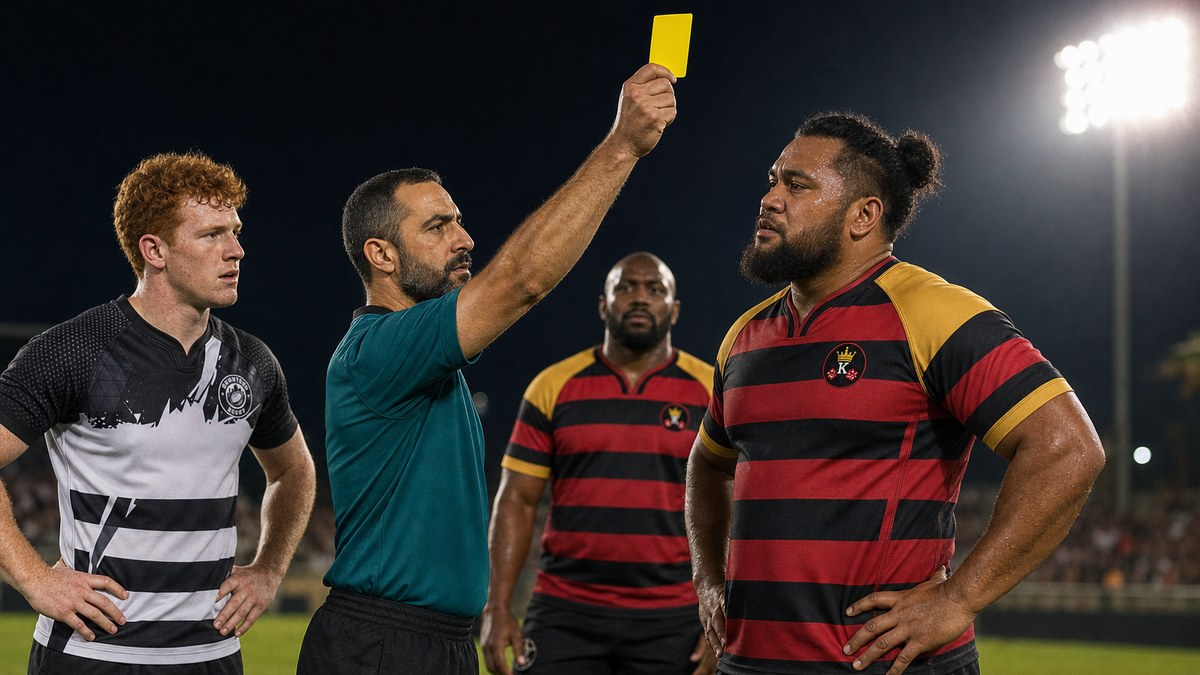
A rugby yellow card sends a player to the sin bin for a set time; a red card sends them off for the rest of the game. That is the simple version, but anyone who watched the USA Eagles this autumn saw that modern rugby discipline has more layers: a yellow card that becomes a red after a review, a red card where the team gets a replacement after 20 minutes, and a television match official working alongside the referee. In 10s and 7s, the sin bin is a completely different length again.
This guide explains how cards work in rugby union under World Rugby's laws as they stand in November 2026, including the changes that became full law on July 1, 2026. It is written for players, coaches and fans, especially anyone getting ready for 10s rugby at the APR Games 2027 in Las Vegas on Memorial Day Weekend, May 29–31, 2027. We cover what earns a card, how long a sin bin lasts in each format, the 20-minute red card, the foul play review, the new community tackle height and, most usefully, how teams can coach discipline so they keep 10 players on the field.
- Yellow card = temporary suspension. Under Law 9 it lasts 10 minutes in 15s. In World Rugby's 10s and 7s variations it lasts 2 minutes.
- Two yellows = red. A second yellow-card offence in the same match means the player is sent off.
- Red card = sent off. In elite rugby, competitions can now use the 20-minute red card: the player stays off, but the team may bring on a replacement after 20 minutes of playing time, unless the act was intentional and highly dangerous.
- The 20-minute red is now full law. World Rugby's Council approved it at its 2026 meeting, effective July 1, 2026, for elite competitions that choose to use it.
- Community tackle height has dropped. From July 1, 2026, community rugby uses the base of the sternum or the waist as the legal tackle height (unions choose); elite rugby keeps the shoulder line.
Why Rugby Uses Cards at All
Most rugby offences are dealt with by a penalty kick, a free kick or a scrum. Cards are for something different: foul play. World Rugby's Law 9 groups foul play into five families — obstruction, unfair play, repeated infringements, dangerous play and misconduct — and gives the referee extra sanctions on top of the penalty when an offence is serious or repeated. Those sanctions are the yellow card (a caution and temporary suspension, Law 9.29) and the red card (a sending-off, Law 9.30).
The logic is simple. A penalty fixes the immediate unfairness by giving the ball and territory to the other team. A card changes the balance of the game for a period, so that cynical or dangerous play costs more than it gains. That matters most in rugby's dangerous-play category, where the sport's priority is protecting players' heads and necks.
APR's view: the best way to understand cards is to see them as a team problem, not just an individual one. Every card leaves fourteen, nine or six teammates covering more ground. In short formats like 10s, that cost arrives fast.
The Yellow Card: What It Means and How Long It Lasts
A yellow card is a caution plus a temporary suspension. The player leaves the field and cannot be replaced while suspended, so the team plays a player short. When the suspension ends, the player returns at a stoppage with the referee's permission. Play restarts after the offence with a penalty to the other team, unless a try has been scored or a penalty try awarded.
How long the player sits out depends on the format:
| Format | Game length (World Rugby law) | Yellow card suspension | Share of the game |
|---|---|---|---|
| 15s (Law 9.29) | 80 minutes (2 × 40) | 10 minutes | 12.5% |
| 10s (World Rugby variation) | 20 minutes (2 × 10); organisers may vary it | 2 minutes | 10% of a 20-minute game |
| 7s (World Rugby variation) | 14 minutes (2 × 7) | 2 minutes | about 14% |
| APR Games 10s | 40 minutes (2 × 20, an organiser variation) | To be confirmed with player registration | — |
Two things stand out. First, the sin bin in 10s is short in minutes but not in impact: with only ten players on a full-width pitch, losing one opens up a huge amount of space. Second, World Rugby's 10s variation is written for 20-minute games. The APR Games plays two 20-minute halves, which is a legitimate organiser variation, and APR's full competition rules — including sin-bin length — will be confirmed with player registration. We explain the match length in detail in How Long Is a Rugby Game?
Common yellow-card offences
- Cynical or professional fouls: deliberately knocking the ball forward to stop a likely try, killing the ball at a ruck near your own line, or taking a player out off the ball.
- Repeated infringements: when a team keeps conceding penalties in the same area, the referee can card the next offender, even if that individual has only offended once. A run of scrum penalties is a classic route to a yellow for a prop.
- Dangerous play below the red-card threshold: for example, a high tackle where the referee finds mitigation, or a late or reckless tackle.
- Misconduct: dissent, retaliation or fighting can all earn a yellow or worse.
A penalty try often comes with a yellow card. If foul play prevents a probable try, the referee awards a penalty try (seven points, no conversion needed) and usually sends the offender to the sin bin.
The second yellow
Law 9.29 is clear: if a player who has already been yellow-carded commits another yellow-card offence in the same match, they are sent off. Two yellows make a red. In elite competitions that use the 20-minute red card, the competition's own regulations set out exactly how a two-yellow red is handled, so check them rather than assuming.

The Red Card: Sent Off, and What Happens Next
A red card (Law 9.30) means the player is sent off and takes no further part in the match. In most rugby — including almost all community, college and club games in the USA — a red-carded player cannot be replaced, so the team plays a player short for the rest of the game.
Red cards are reserved for the most serious foul play: dangerous tackles with significant head contact and no mitigation, dangerous cleanouts, tip tackles, striking, stamping, kicking or biting, as well as a second yellow-card offence. A red card also usually leads to a disciplinary process after the game. World Rugby's Regulation 17 governs discipline at international level, and national unions and competitions run their own processes; suspensions depend on the offence and the circumstances, so we won't guess at numbers here.
Dangerous tackling: what Law 9.13 now says
Because most cards in modern rugby come from the tackle, it is worth knowing the wording. Law 9.13 lists dangerous tackling as including tackles that lead to head contact, tackles above the relevant sanction line in open play, and hip-drop tackles, alongside early, late and otherwise dangerous tackles. The "relevant sanction line" is the key phrase, because it now depends on the level of the game.
The 20-Minute Red Card, Explained
The 20-minute red card is the biggest change to rugby discipline in years. It started as a trial in some competitions, became a World Rugby global law trial for elite rugby from July 1, 2025, and was approved as full law by World Rugby's Council at its 2026 meeting in Dublin, effective July 1, 2026. Elite competitions may choose to use it.
Here is how it works, based on World Rugby's law wording:
- The red-carded player is still sent off. They never come back. Nothing about the individual sanction changes.
- The referee decides which type of red it is. For intentional and highly dangerous actions, the player cannot be replaced, so the team plays a player short for the rest of the match, exactly like a traditional red.
- For other red-card offences, the team may bring on a replacement once 20 minutes of playing time have passed.
- The replacement comes from the bench. Under the trial wording, the replacement is a tactically replaced player returning to the field, and they can only replace the teammate who received the qualifying red card.
- It is for elite rugby. World Rugby defines elite rugby as professional rugby, and each competition decides which laws and protocols apply. Community rugby keeps the traditional red card.
| Card | Player returns? | Team down a player for | Where it applies |
|---|---|---|---|
| Yellow (15s) | Yes, after 10 minutes | 10 minutes | All rugby |
| Yellow (10s, 7s) | Yes, after 2 minutes | 2 minutes | World Rugby 10s and 7s variations |
| 20-minute red | No | 20 minutes, then a replacement may come on | Elite competitions that adopt it |
| Full red | No | Rest of the match | All rugby; in elite rugby, for intentional and highly dangerous actions |
A real example from American soil
Fans in Nashville saw the 20-minute red card on October 24, 2026, when Australia A played the USA at GEODIS Park. Australia A's David Feliuai was shown a yellow card in the 15th minute for a high shot on Tavite Lopeti; after review, it was upgraded to a 20-minute red. Australia A still scored while short-handed and went on to win 61–12. We covered the game in our Nashville weekend analysis and the full series in our October series review.
APR's take: the 20-minute red protects the contest without excusing the act. The sent-off player is still gone and still faces discipline. What changes is that one mistimed tackle no longer decides an 80-minute game on its own. Critics argue it softens the deterrent for dangerous tackles; supporters argue the deterrent was always the suspension, not the scoreline. Both views are worth hearing, and World Rugby made it optional for competitions for a reason.
The Foul Play Review: How a Yellow Becomes a Red
At the top level, the referee is no longer alone. The television match official's role was formally written into law from July 1, 2026, and many elite competitions also use a foul play review process, often called "the bunker". World Rugby explains the process like this:
- The referee and TMO look at an incident on the big screen. If they agree it is at least a yellow but cannot decide whether it is a red after two replays, the referee crosses their arms to signal a formal review.
- The player goes to the sin bin straight away.
- A Foul Play Review Officer reviews all available angles, with up to eight minutes to decide. Eight minutes is a maximum, not a set time.
- The referee then either confirms the yellow card, so the player returns after the sin bin, or upgrades it to a red.
This is why you sometimes see a player trudge off with a yellow and then learn, mid-way through the sin bin, that they will not be coming back. In community rugby there is no TMO or bunker: the referee's decision on the field is final, which is one more reason to coach players to stay well clear of the red-card zone.

The 2026 Community Tackle Height Law
The other big July 2026 change affects far more players than the 20-minute red: World Rugby lowered the legal tackle height for community rugby. Council approved it at the same 2026 meeting, and it applies to seasons starting after July 1, 2026.
- Elite rugby: the sanction line stays at the line of the shoulders.
- Community rugby: the sanction line is the base of the sternum or the waist. Under the "Game On" community variations, the match organiser or union chooses which.
- Sanction: tackling above the relevant sanction line is a penalty under Law 14 and counts as dangerous tackling under Law 9.13, so it can also lead to a card.
- Ball carriers have duties too: the law says the ball carrier has a responsibility to enter the tackle safely, and an optional Game On clause penalises a carrier who significantly lowers their height just before making dangerous contact.
World Rugby says trials across 10 member unions studied more than 150,000 tackles over two years, and that a lower tackle height reduced upright tackles — the type most likely to cause avoidable head impacts. A lower tackle height is also being trialled in elite rugby, starting with the World Rugby Junior World Championship in Georgia in 2026.
What does that mean in America? Most of the rugby played in the USA is community rugby: club, college, high school, youth and social. The exact height and start date for your league depend on how USA Rugby and your competition apply the law, so check with your club, conference or referee society before the season. If you are coaching, the safe assumption is simple: teach every player to tackle at the waist or lower, with the head to the side and both arms wrapping.
Keep 10 on the field. Bring your team to the APR Games.
The APR Games is a 10s rugby tournament on Memorial Day Weekend in Las Vegas, with evening kickoffs under floodlights and $15,000 in prize money. Player entry is $299 and includes an official APR Games team jersey, a full kit bag, a minimum of three guaranteed pool games, opening-night access and a player profile on americanprorugby.com. The APR Coaching Clinic runs May 28–31, 2027.
Referee Signals for Cards and Foul Play
World Rugby splits referee signals into primary signals (what happens next: try, penalty, free kick, scrum, advantage), secondary signals (why play stopped) and tertiary signals (extra information). The ones linked to discipline are worth knowing so you can read a game from the stands or the bench:
| Signal | What the referee does | What it means |
|---|---|---|
| Penalty | Arm raised straight and angled up toward the non-offending team | Penalty kick awarded; the team can kick for goal, kick to touch, tap or scrum |
| Free kick | Arm bent at the elbow, upper arm pointing toward the non-offending team | Lesser offence; no kick at goal |
| Advantage | Arm held out at waist height toward the non-offending team | Play continues while the team that was offended against looks for a gain |
| Yellow card | Card held up toward the player | Temporary suspension (sin bin) |
| Red card | Card held up toward the player | Sent off |
| Foul play review | Arms crossed in front of the chest | Player goes to the sin bin while the incident is reviewed for a possible red |
| TMO referral | Hands draw a rectangle, like a screen | The referee is asking the TMO to check the incident |
The full set of signals is pictured in World Rugby's law book. If you want to go deeper, World Rugby Passport has free officiating courses, and USA Rugby supports referee development across the country.
Why Discipline Matters Even More in 10s
In 15s, a team down to fourteen can often survive ten minutes by kicking for territory and slowing the game. In 10s, losing one of ten players is losing 10% of your team on a pitch that is still full width. Defensive lines stretch, overlaps appear on the edges and every missed tackle becomes a line break. The two-minute sin bin in World Rugby's 10s variation is short, but two minutes of open-field 10s can easily produce a try or two.
The penalty that comes with the card hurts as well. In 10s, a quick tap penalty against a reorganising defence is one of the most dangerous plays in the game. And because tournaments run on points difference and tight pool tables, a single card can decide who makes the final.
Our guide to 10s rugby positions shows how every player in a ten-man line has a job. Take one away and somebody else has to do two.
How to Coach Discipline: A Practical System for 10s Teams
Cards are rarely random. They come from habits: tackling technique, how players react under fatigue, and how a team handles referees. Here is a practical system coaches can use in season and in the build-up to a tournament.
1. Build tackle technique around the lower height
Most red cards come from head contact in the tackle. Coach low, two-armed tackles with the head to the side, and practise them when players are tired, because technique falls apart late in games. World Rugby's free Tackle Ready and Rugby Ready courses on World Rugby Passport are the right starting point, and USA Rugby requires coaches to complete Rugby's Safety Basics, with World Rugby Level 1 required for coaches of tackle rugby. Our guide to starting rugby as an adult in Las Vegas points new players to local clubs and coaching.
2. Train decisions at the breakdown
Repeated breakdown penalties lead to team warnings and then cards. Run short games where the defence must decide in a second: compete for the ball legally, or roll away and fold into the line. Reward the right decision, not just the turnover.
3. Rehearse the "down to nine" plan
Every 10s team should have a plan for playing a player short. Decide in training who drops out of the backline, how the defence narrows, and whether you kick to touch to burn time. Practise it for two-minute blocks so it feels normal on the day.
4. Manage fatigue
Late, tired tackles are high, upright tackles. Conditioning is a discipline tool. Our 8-week rugby training plan for 10s builds the repeated-effort fitness that keeps technique together in the second half.
5. One voice to the referee
Only the captain talks to the referee. Ask questions calmly and briefly, accept the answer and move on. Dissent costs ten metres at best and a card at worst.
6. Track it
Keep a simple record of penalties and cards by type: tackle, breakdown, offside, scrum, dissent. Patterns appear within a few games. If your club wants to build a simple tracking app, Vibe Coding explains how people build their own tools with AI.
Discipline Drill Ideas for Team Sessions
These are team-organisation drills, not single-skill technique sessions. For handling technique, see our weekly Tuesday Skills series: spin pass, catching and hands ready and the pop pass.
| Drill | Setup | What it trains |
|---|---|---|
| Sin-bin game | Small-sided game; the coach randomly removes a defender for 2 minutes | Narrowing the line, communication and the down-a-player plan |
| Ruck decision game | 3v3 contact game; the coach calls "compete" or "release" as the tackle happens | Legal breakdown decisions under pressure |
| Penalty count challenge | Full team game; the team that concedes three penalties loses possession and a player for one minute | Team accountability for discipline |
| Tired tackles | Conditioning block followed immediately by controlled, low-speed tackle technique work under a qualified coach | Holding tackle technique under fatigue |
| Quick-tap defence | Award random tap penalties against the defence during games | Reorganising after a penalty, the most dangerous moment after a card |
Common Myths About Rugby Cards
- "A yellow card is always 10 minutes." Only in 15s. World Rugby's 10s and 7s variations use 2 minutes.
- "A 20-minute red means the player comes back." No. The red-carded player is gone for good; only a replacement can come on after 20 minutes.
- "Every red card is now a 20-minute red." No. It applies only in elite competitions that adopt it, and never for intentional and highly dangerous actions.
- "Community rugby uses the bunker." No. The foul play review relies on TV coverage and is used in elite competitions.
- "The new tackle height applies everywhere." No. The waist or base-of-sternum line is for community rugby; elite rugby keeps the shoulder line, with a lower height being trialled.
What It Means for the APR Games
The APR Games is 10s rugby for everyone: Men's Elite and Women's Social divisions play two 20-minute halves under floodlights, with age-appropriate formats for Youth. Full rules and squad sizes have not been published yet and will be confirmed with player registration, so we are not going to guess at the tournament's sin-bin length or card procedures. What we can say is that discipline will matter. In a tournament with a minimum of three guaranteed pool games per player and finals on Monday, May 31, one card at the wrong moment can change a pool.
The founding franchises in our images — the Vegas Kings and Downtown Rugby — are two of the five Las Vegas teams, alongside the Vegas Knights, Vegas Blackjacks and Vegas Lions, plus one mystery invitational team. See them all on the teams page.
Coming to Vegas for the weekend? Our partner Luna Appleton publishes guides on where to stay, eat and celebrate on the Strip once the final whistle goes.
The APR Games is made possible by our partners. Players and fans can support the businesses that support American rugby:
Launching a rugby business or club venture? Giftabiz lets friends, family and community back a new business launch with gifts and video messages, and American LED Signage designs and installs commercial LED signs for venues and businesses.
Frequently Asked Questions
How long is a yellow card in rugby?
In 15-a-side rugby union, a yellow card means a 10-minute temporary suspension under Law 9.29. In World Rugby's 10s and 7s variations, the suspension is 2 minutes. Competitions can publish their own rules, so always check the tournament regulations.
What happens if a rugby player gets two yellow cards?
A player who commits a second yellow-card offence in the same match is sent off, the same as a red card. They take no further part in the game.
Can a team replace a player who gets a red card?
In most rugby, no. In elite competitions that use the 20-minute red card, a replacement may come on after 20 minutes of playing time, except when the red card was for an intentional and highly dangerous act. The red-carded player never returns.
Is the 20-minute red card now permanent?
Yes, for elite rugby. World Rugby's Council approved it as full law in 2026, effective July 1, 2026. Elite competitions may choose whether to use it; community rugby keeps the traditional red card.
What is the bunker in rugby?
The bunker is the foul play review process used in some elite competitions. If the officials agree an incident is at least a yellow but cannot rule out a red, the player goes to the sin bin and a Foul Play Review Officer has up to eight minutes to decide whether to upgrade the card to red.
What is the new tackle height in community rugby?
From July 1, 2026, community rugby uses the base of the sternum or the waist as the legal tackle height, with the union or match organiser choosing which. Elite rugby keeps the line of the shoulders. Check with your union or league for when and how it applies to your games.
Can a yellow card lead to a penalty try?
Yes. If foul play prevents a probable try, the referee awards a penalty try worth seven points and usually shows the offending player a yellow card.
Does a red card mean a suspension for future games?
Usually a red card leads to a disciplinary review after the match, which can result in a suspension. The length depends on the offence, the circumstances and the rules of the union or competition.
How long is a sin bin at the APR Games?
APR Games rules and squad sizes will be confirmed with player registration. For reference, World Rugby's 10s variation uses a 2-minute temporary suspension. All APR Games divisions play 10s over two 20-minute halves on May 29–31, 2027.
Are the players in the images real?
No. The images are illustrations of fictional players wearing the kits of two founding APR franchises, the Vegas Kings and Downtown Rugby. They do not show a real match, incident or result.
Keep Reading
Want more? Sign up to the APR newsletter, catch up on the latest rugby news, see the divisions on the APR Games page, or kit yourself out at the APR merch store. Building a squad? Find your franchise in the teams section.
Sources
- World Rugby Passport: Law 9 — Foul play
- World Rugby Passport: 10s variation — Law 9 foul play
- World Rugby Passport: 2026-07 Law updates
- World Rugby Passport: 2025-07 Global Law Trial — 20-minute red card replacement
- World Rugby Passport: Community tackle height law wordings approved
- World Rugby: World Rugby lowers legal tackle height in community rugby (June 2026)
- RugbyPass: New tackle height among five law changes confirmed by World Rugby
- World Rugby: Foul play review process — how does it work?
- World Rugby Passport: The signals
- USA Rugby: Coaching training and education
This guide is for general education and is current as of November 4, 2026. It is a plain-English summary, not the official law text: the World Rugby law book and your competition's regulations always take priority. Learn tackling and contact skills under a qualified coach. APR Games rules and squad sizes will be confirmed with player registration. Questions? Contact us.