Rugby Referee Signals Explained: Every Key Hand Signal and What It Means
Penalty or free kick? Advantage or knock-on? A plain-English guide to the referee signals in rugby union, based on World Rugby's official descriptions, with what each one means for players, coaches and fans heading to the APR Games 2027 in Las Vegas.
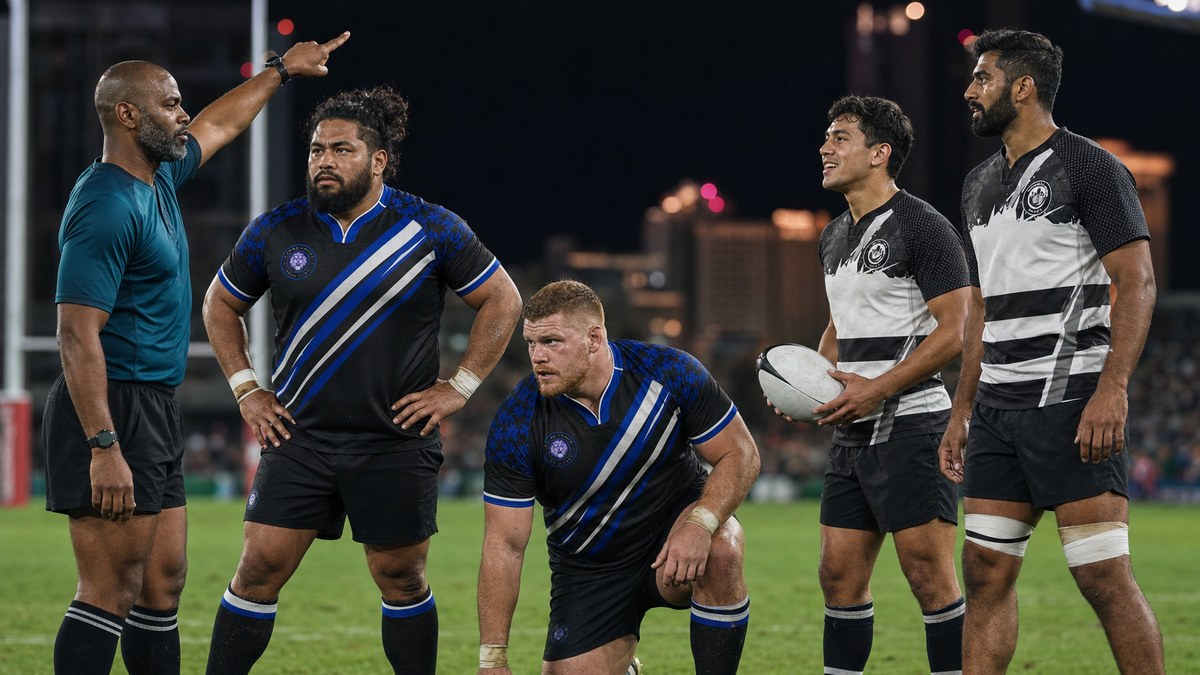
Rugby referee signals are the language of the game. Every time the whistle goes, the referee uses an arm, a hand or a card to tell 30 players (or 20, in 10s), the coaches and every fan in the stands what happens next and why. If you know the signals, a rugby match stops looking like a series of random stoppages and starts making sense.
This guide explains the signals used in rugby union under World Rugby's laws as they stand in November 2026. We quote World Rugby's own descriptions where it matters, group the signals the way the law book does, and add practical notes for players and coaches getting ready for the APR Games 2027, the 10s rugby tournament in Las Vegas on Memorial Day Weekend, May 29–31, 2027. If you are new to the sport, start with our explainer on what 10s rugby is, then come back here.
- Three layers. World Rugby groups signals into primary (what happens next), secondary (why play stopped) and other or "tertiary" signals (extra information such as injuries or time off).
- Order matters. Referees signal in sequence: first what happens next, then the reason, then any extra information.
- The big four restarts: scrum (arm horizontal), free kick (arm bent square at the elbow), penalty (arm angled up) and try (arm raised vertically).
- Advantage is an arm held out at waist height toward the team that was offended against, for about five seconds.
- Assistant referees use flags: raised for touch or a successful kick at goal, held horizontally and pointing infield for foul play.
Why Rugby Referees Use Signals
Rugby is a noisy, crowded sport. A referee standing at a ruck can talk to the players around the ball, but the winger 40 meters away, the coach in the stand and the fan watching on a phone cannot hear a word. Signals solve that. World Rugby's officiating guidance describes the signals as part of the law book, where each one is pictured and described, so that a penalty in Las Vegas looks the same as a penalty in Tbilisi or Toronto.
World Rugby explains that the four main stoppage decisions are a try, a penalty kick, a free kick and a scrum. Those signals, plus advantage, are the primary signals. Because the reason for a penalty or a free kick is not always obvious to players and spectators, there is a second set of signals, the secondary signals, and each one is linked to a primary signal. A third set covers extra information such as forming a scrum, a bleeding wound or calling the timekeeper.
World Rugby also sets the order. Referees apply the signals in a sequence: first, what will happen next (the primary signal); second, why play stopped (the secondary signal); third, any additional information (the tertiary signal). So when you see a referee point a straight arm toward one team, then mime a forward pass, you are watching a scrum to that team, caused by a forward pass, in exactly the order the law book expects.
APR's view: signals are not just for fans. Players who read them quickly make better decisions. A scrum-half who sees the penalty arm go up before the whistle has finished can take a quick tap while the defense is still turning around. In 10s, with only ten players a side and more space on the field, those seconds are often the difference between a try and a reset.
The Primary Signals: What Happens Next
These are the signals you need to learn first. World Rugby's primary signal index lists seven: scrum, free kick, penalty, advantage, try and penalty try, no try, and drop-out. Here is what the referee does for each, using World Rugby's own descriptions.
| Signal | What the referee does (World Rugby description) | What it means |
|---|---|---|
| Scrum | "Shoulders parallel with touchline. Arm horizontal pointing towards team to throw in the ball." | A scrum, with the put-in to the team the arm points at |
| Free kick | "Shoulders parallel with touchline. Arm bent square at elbow, upper arm pointing towards non-offending team." | A lesser offence; the team gets a kick but cannot kick at goal |
| Penalty | "Shoulders parallel with touchline. Arm angled up, pointing towards non-offending team." | A penalty; the team can kick at goal, kick to touch, tap and run, or choose a scrum |
| Advantage | "Arm outstretched, waist high, towards non-offending team, for a period of approximately five seconds." | Play goes on while the team that was offended against tries to gain from it |
| Try and penalty try | "Referee's back to dead-ball line. Arm raised vertically." | Try awarded (5 points), or a penalty try (7 points) |
| No try | "Arms crossed then uncrossed in front of the body." | The ball was not grounded legally; no score |
| Drop-out | "Arm points to relevant drop-out line" | Play restarts with a drop kick from the 22-meter line or the goal line |
How to tell a penalty from a free kick
This is the one most new fans get wrong, and it matters because the options are so different. Both signals start the same way: the referee stands side-on, shoulders parallel to the touchline, and uses the arm nearest the team that gets the ball. For a penalty, the arm is straight and angled up. For a free kick, the arm is bent square at the elbow, so the upper arm points at the team and the forearm points straight up. A simple way to remember it: a straight arm means a stronger sanction.
A penalty gives the team a shot at goal, a kick to touch with the throw-in to follow, a quick tap or a scrum. A free kick does not allow a kick at goal. If you are ever unsure in the stands, watch the captain: if the team points at the posts, it was a penalty.
Advantage: the signal that keeps the game moving
Advantage is the most important signal in open play, and it is often misunderstood. When one team infringes, the referee does not have to stop the game. If the other team could benefit by playing on, the referee holds an arm out at waist height toward them for about five seconds and lets play continue. If they gain a real advantage, the earlier offence is forgotten. If they do not, the referee blows the whistle and goes back to the original mark.
For players, the lesson is simple: when you see the advantage arm, attack. You have what amounts to a free play. Try the long pass, the chip kick or the risky offload, because if it goes wrong the referee will usually bring play back. For defenders, the lesson is the opposite. Keep working, because advantage can be over in a few seconds.

Try, penalty try and no try
The try signal is the one every fan knows: the referee stands with their back to the dead-ball line and raises an arm straight up. The same signal is used for a penalty try, which is awarded when foul play stops a probable try. A penalty try is worth 7 points and there is no conversion. When the ball is not grounded, the referee crosses and uncrosses both arms in front of the body for "no try." For how the clock, stoppages and scoring fit together across 15s, 10s and 7s, see our guide to how long a rugby game lasts.
The Secondary Signals: Why Play Stopped
Secondary signals explain the reason behind the decision. World Rugby lists more than 30 of them, from a forward pass to dissent. You do not need to memorize them all on day one, but the ones below come up in almost every match. Watch for them straight after the primary signal.
| Secondary signal | What the referee does (World Rugby description) | Usually leads to |
|---|---|---|
| Throw forward / forward pass | "Hands gesture as if passing an imaginary ball forward." | Scrum to the other team |
| Knock forward (knock-on) | "Arm outstretched with open hand above head, and moves backwards and forwards." | Scrum to the other team |
| Not releasing the ball in the tackle | "Both hands are close to the chest, as if holding an imaginary ball." | Penalty |
| Tackler not releasing the tackled player | "Arms brought together as if grasping a player and then opening as if releasing a player." | Penalty |
| Joining a ruck or maul from the side | "The hand and arm held horizontally, moving sideways." | Penalty |
| Handling the ball in a ruck or scrum | "Hand at ground level, making sweeping action, as if handling the ball." | Penalty |
| Intentionally collapsing a ruck or maul | "Both arms at shoulder height as if bound around opponent. Upper body lowered and twisted as if pulling down opponent who is on top." | Penalty |
| Offside at scrum, ruck or maul | "Shoulders parallel with touchline. Arm hanging straight down, swings in arc along offside line." | Penalty |
| Unplayable ball in ruck or tackle | Arm horizontal toward the team to throw in, the other arm pointing toward the other team's goal line and moving back and forth | Scrum |
| Throw at lineout not straight | "Shoulders parallel with touchline. Hand above head indicates the path of the ball, not straight." | Option of a lineout or scrum to the other team |
| Ball held up in in-goal | "Space between hands indicates that ball was not grounded." | No try; restart per the law |
| High tackle (foul play) | "Hand moves horizontally in front of neck." | Penalty, and possibly a card |
| Dissent | "Outstretched arm with hand opening and closing to imitate talking." | Penalty, often marched forward |
The breakdown signals decide most games
Look at that table again: most of the penalty signals come from the tackle and the ruck. Not releasing, not rolling away, coming in from the side, hands in the ruck, offside at the back foot. That matches what coaches see at every level. The breakdown is where teams win or lose possession, and it is where referees blow the whistle most often.
That is why understanding these signals is a coaching tool, not just trivia. If your team keeps getting the "hands at ground level" signal, your players are going off their feet and handling in the ruck. If you keep seeing the "arm swinging along the offside line" signal, your defensive line is creeping past the back foot. Each signal points straight at a habit you can fix in training. Our Tuesday Skills guide to safe tackling covers the tackler's job of releasing and getting back to their feet, and the next episodes in the series will move on to ball carrying and placement after the tackle.
Forward pass and knock-on: the scrum signals
The two most common reasons for a scrum are the forward pass and the knock-on. For a forward pass, the referee mimes passing an imaginary ball forward. For a knock-on, the referee raises an open hand above the head and moves it back and forth. In both cases, you should already have seen the primary scrum signal, an arm straight out toward the team that gets the put-in. If you need a refresher on why a pass must travel backward, our episode on the pop pass and the earlier one on catching both cover the technique that keeps the ball going the right way.
Know the signals. Play the tournament.
The APR Games is a 10s rugby tournament on Memorial Day Weekend in Las Vegas: two 20-minute halves, evening kickoffs under floodlights and $15,000 in prize money. Player entry is $299 and includes an official team jersey, a full kit bag, at least three guaranteed pool games, opening-night access and a player profile. Join the waitlist now, and see the Coaching Clinic (May 28–31, 2027).
Other Signals: Cards, the TMO, Injuries and Time Off
World Rugby's third group covers decisions and information that are not about the restart itself. These are the ones you will notice most at a professional game, because they often come with a stoppage, a big-screen replay or a player leaving the field.
| Signal | What the referee does | What it means |
|---|---|---|
| Yellow card | "The card is raised in the air to a player" | The player is cautioned and goes to the sin bin |
| Red card | The card is shown to the player | The player is sent off for the rest of the match |
| Referee consults TMO | "Extended index fingers draw a rectangle to represent a television screen." | The referee wants the television match official to check something |
| Time off | "Arms form a T shape." | The clock stops, usually for an injury or a review |
| Head injury assessment required | "Abducted arm flexes and extends to touch head." | The player must leave for a head injury assessment |
| Foul play review | Arms crossed in front of the chest (elite competitions that use the review) | The player goes to the sin bin while the incident is reviewed for a possible red card |
The cards themselves have their own rules: how long a sin bin lasts in 15s, 10s and 7s, what two yellows mean, and how the 20-minute red card works in elite rugby since July 1, 2026. We covered all of that in Rugby Yellow and Red Cards Explained, so this guide sticks to the signals.
The TMO rectangle
At televised games, the "rectangle" is one of the most recognizable signals in the sport. The referee draws a screen shape in the air with both index fingers to show they are going to the television match official. Under Law 6, the TMO uses technology to help the referee, and any match official can recommend a review. In community rugby and at most amateur tournaments there is no TMO, so you will rarely see this signal outside the pro game. APR Games officiating arrangements will be confirmed with player registration.
Head injury and time off
Two signals deserve special respect because they are about safety. When a referee touches their own head with a bent arm, a player needs a head injury assessment. When the referee forms a "T" with both arms, time is off. Players should never argue with either. If you coach a club team, teach your players what these signals mean in your first session of the season, and make sure your coaches have completed World Rugby's concussion education, which USA Rugby requires as part of its coaching basics.
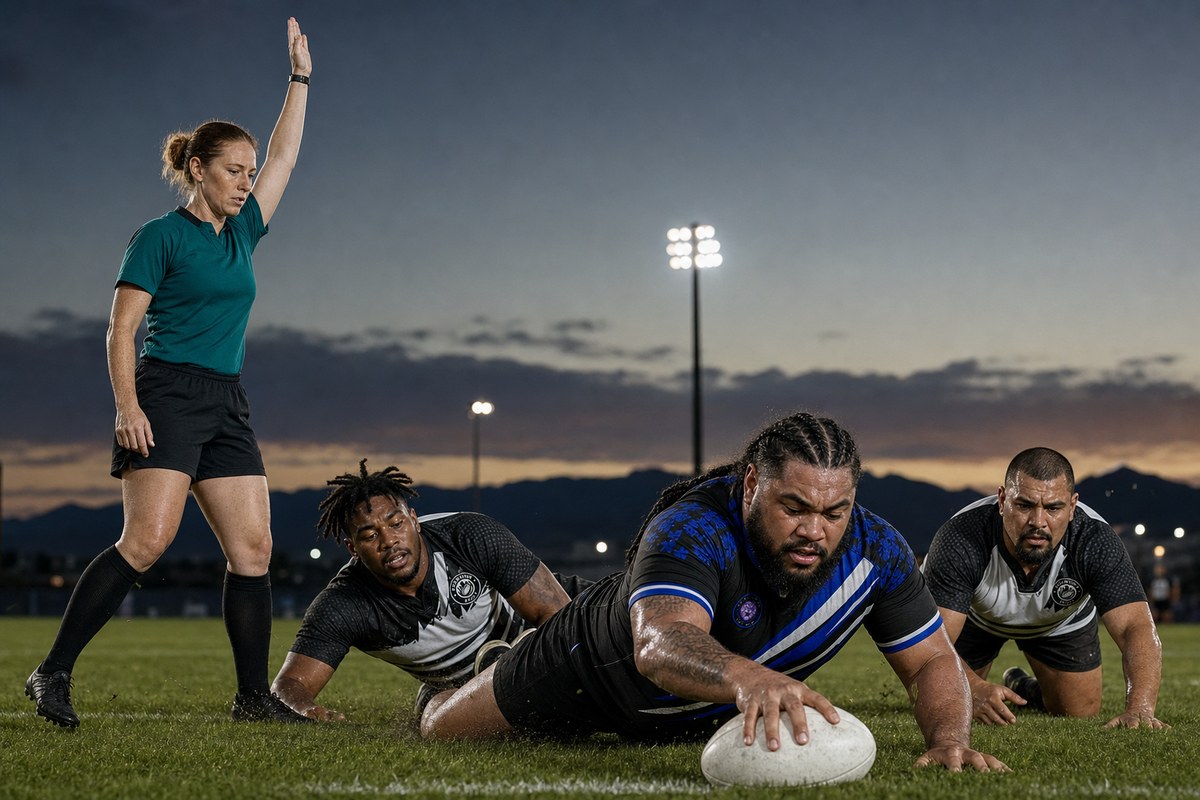
Assistant Referee Signals: Reading the Flags
The referee is not the only official signalling. The two assistant referees (or touch judges at many club games) carry flags and use them to signal decisions. Law 6 describes three main flag signals:
- Touch and team to throw: when the ball or the ball carrier goes into touch, the assistant referee holds up the flag and points to the team entitled to throw in. The flag comes down when the ball is thrown in, with a few listed exceptions.
- Kick at goal successful: when a conversion or penalty goes over the crossbar and between the posts, both officials behind the posts raise their flags to signal the goal.
- Foul play: the assistant referee holds the flag horizontally and points infield at right angles to the touchline. That tells the referee they have seen foul play that needs attention.
Law 6 also allows the referee to change a decision after a touch judge or assistant referee has raised the flag. So when you see a flag go out horizontally and the referee jog over to the touchline, expect a conversation, and possibly a penalty to the other team.
Referee Signals in 10s Rugby and at the APR Games
The good news for 10s players is that the signals do not change. World Rugby's 10s variation changes things like match length, the number of players and the length of a sin bin, but the referee still uses the same primary, secondary and other signals described in the law book. A penalty arm in a 10s game means exactly what it means in 15s.
What does change is the speed. In 10s there are five forwards and five backs, a five-player scrum and more space on the field. Our guide to 10s rugby positions shows how that space opens up the game. That means:
- Quick taps are deadly. When the penalty arm goes up and the defense is still retreating, a quick tap often leads to a try. Teach your half-backs to look for the signal, not wait for a team talk.
- Advantage matters more. With more space, a team playing advantage can often go 30 or 40 meters in a few seconds. Play on while the arm is out.
- Breakdown discipline is everything. With fewer players at the ruck, one player coming in from the side or off their feet can hand the other team three points or an attacking lineout.
- Dissent is a waste. The dissent signal usually costs your team ground. In a 40-minute game, that ground is hard to win back.
The APR Games play two 20-minute halves, a legitimate organiser variation of World Rugby's 10s law, which allows organisers to vary match duration. Full APR rules, including squad sizes and sin-bin length, will be confirmed with player registration. Until then, the World Rugby law book is the best guide, and every signal in this article applies. If you are building a squad, our guide on how to build a 10s rugby team covers registration, roles and timelines, and the 8-week rugby training plan will get your players fit enough to keep their discipline late in a game.
How to Learn the Signals Fast: A Coach's Plan
Knowing the signals is a skill like any other. You learn it by repetition, ideally in a game-like setting. Here is a simple plan coaches can use over three weeks of normal training, with no extra time needed.
| Week | Focus | How to run it |
|---|---|---|
| Week 1 | The primary signals | Coach referees every small-sided game using only the seven primary signals. Players shout the decision ("Penalty, blue!") before the coach speaks. |
| Week 2 | Breakdown signals | In contact sessions, add the secondary signals for not releasing, hands in the ruck, side entry and offside. Freeze play after each one and ask the offender to name the fix. |
| Week 3 | Play to the signal | Reward quick decisions: a team that takes a quick tap within three seconds of a penalty signal, or plays on under advantage, earns a bonus point in the game. |
Use the signals to cut penalties
Keep a simple tally at every game: which secondary signal did the referee give against your team, and how many times? After three or four games, the pattern usually jumps out. If most of your penalties come with the "holding an imaginary ball" signal, your ball carriers are not placing the ball after the tackle. If they come with the "arm swinging along the offside line" signal, your defense needs work on the back foot. Every signal is feedback.
It also helps to watch the pro game with the sound off. Pick one televised match a week, mute it, and call the decisions out loud from the signals alone. You will be surprised how fast your players' reading of the game improves. World Rugby's free Passport platform has pictures and short descriptions of every signal, which makes it an ideal homework link to share with a squad.
Become a referee yourself
The best way to understand signals is to give them. USA Rugby runs referee and coach education, and every coach and referee must complete Rugby's Safety Basics, which includes World Rugby's Rugby Ready and concussion courses, plus SafeSport training. Many clubs need more referees, and refereeing a few youth or social games will make you a smarter player. Ask your local referee society or start at USA Rugby's coaching and education pages.
Signals in the Stands: A Fan's Cheat Sheet
Coming to the APR Games or watching your first live match? Here are the five signals that will help you follow the game straight away:
- Arm straight up, back to the dead-ball line: try. Celebrate.
- Arm angled up toward one team: penalty to that team. Watch whether they point at the posts.
- Arm bent at the elbow: free kick. No kick at goal.
- Arm straight out sideways: scrum to the team it points at.
- Arm out at waist height: advantage. Play on; something just happened that the referee may come back to.
Las Vegas is a big-screen city, and modern venues use LED screens to show replays and decisions. Our partner American LED Signage designs and installs commercial LED signs and screens for venues and businesses. Planning the rest of your weekend? Luna Appleton has guides to where to stay, eat and celebrate in Vegas after the evening games.
The APR Games is made possible by our partners. Players and fans can support the people who support American rugby:
Clann13, an APR partner that makes supplements for athletes, also presents our weekly Tuesday Skills series. Building an app to track your team's penalty tally? Learn the basics of AI-assisted coding at Vibe Coding.
Frequently Asked Questions
What are the main referee signals in rugby?
World Rugby lists seven primary referee signals: scrum, free kick, penalty, advantage, try and penalty try, no try, and drop-out. They tell players what happens next. Secondary signals then explain why play stopped, such as a forward pass or a knock-on.
What is the difference between the penalty and free kick signals?
Both are given side-on with the arm toward the non-offending team. For a penalty, the arm is straight and angled up. For a free kick, the arm is bent square at the elbow with the upper arm pointing at the team. A penalty allows a kick at goal; a free kick does not.
What does the advantage signal look like?
The referee holds an arm outstretched at waist height toward the non-offending team for about five seconds. Play continues. If that team gains a real advantage, the offence is forgotten; if not, the referee goes back and awards the original penalty, free kick or scrum.
How does a referee signal a try?
The referee stands with their back to the dead-ball line and raises an arm vertically. The same signal is used for a penalty try, which is worth 7 points with no conversion.
What is the knock-on signal in rugby?
World Rugby describes it as an arm outstretched with an open hand above the head, moving backward and forward. It normally follows the scrum signal, which shows which team gets the put-in.
Why does the referee draw a rectangle in the air?
That is the signal for consulting the TMO, the television match official. The referee uses both index fingers to draw a shape like a TV screen. You will mostly see it at televised professional matches.
What does it mean when the referee forms a T with both arms?
It means time off. The clock stops, usually for an injury, a review or another stoppage, and starts again when the referee signals.
What do the assistant referees' flags mean?
A raised flag means the ball has gone into touch, and the assistant points to the team that throws in. Both flags raised behind the posts mean a successful kick at goal. A flag held horizontally and pointing infield means the assistant has seen foul play.
Are the referee signals different in 10s rugby?
No. World Rugby's 10s variation changes match length, team size and the sin bin, but the referee signals are the same as in 15s. APR Games rules, including sin-bin length and squad sizes, will be confirmed with player registration.
Are the players in the images real?
No. The images are illustrations of fictional players wearing the kits of two APR founding franchises, the Vegas Lions and Downtown Rugby. They do not show a real match, result or referee decision.
Keep Reading
Want more? Sign up to the APR newsletter, catch up on the latest rugby news, see the divisions on the APR Games page, or kit yourself out at the APR merch store. Meet the two franchises in this article's images: the Vegas Lions and Downtown Rugby, plus the Vegas Kings, Vegas Knights and Vegas Blackjacks in the teams section. New to the sport? Read how to start playing rugby as an adult in Las Vegas, or contact us.
Sources
- World Rugby Passport: The signals (primary, secondary and tertiary signals, and the order of use)
- World Rugby Passport: Primary referee signals
- World Rugby Passport: Secondary referee signals
- World Rugby Passport: Other signals — referee consults TMO
- World Rugby Passport: Law 6 — Match officials
- World Rugby Passport: Law 9 — Foul play
- World Rugby: Foul play review process — how does it work?
- USA Rugby: Coaching training and education
This guide is for general education and is current as of November 11, 2026. Signal descriptions are quoted from World Rugby's published law book materials; always check the current Laws of the Game and your competition's rules. APR Games rules will be confirmed with player registration. Images are illustrations of fictional players, not real matches. Questions? Contact us.