Tuesday Skills #5: How to Carry the Ball Into Contact — Leg Drive, Drills and a 3-Week Plan
Getting tackled is part of rugby. Getting tackled well is a skill. Here is how to carry the ball into contact safely, keep your legs driving, win the extra metres and give your team quick ball, with drills for solo, partner and team sessions.
TUESDAY SKILLS #5 · Brought to you by Clann13 — an official APR partner. A new rugby skill, and how to practice it, every Tuesday.
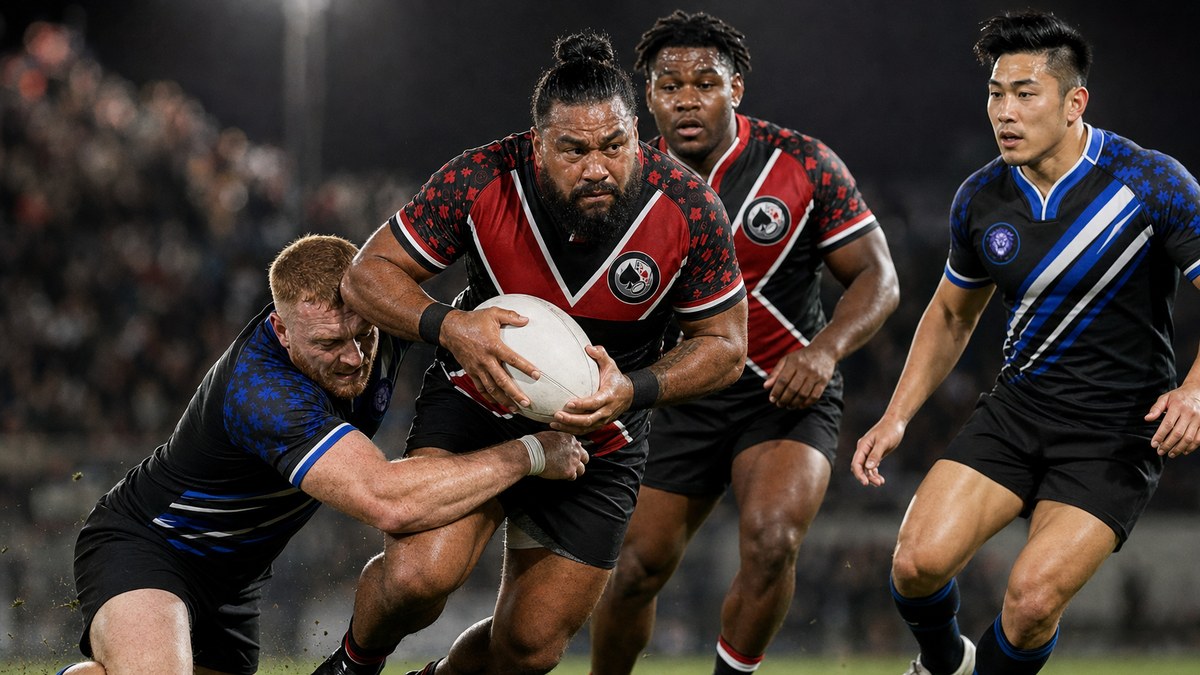
Knowing how to carry the ball into contact is what turns a run into a gain. When there is no space left and a defender is in front of you, a good carry keeps the ball safe in both hands, keeps your body low and square, keeps your head up and your legs pumping, and finishes with the ball presented back to your team. A bad carry is upright, loose and head-first: the ball gets ripped, you go backwards, and you risk getting hurt.
This is episode 5 of Tuesday Skills. We have covered the spin pass, catching, the pop pass and, last week, tackling. This week we look at the other side of the same collision: the ball carrier. Because carrying into contact is a contact skill, the same rule applies as last week: practice the contact parts under a qualified coach. Use this guide to understand the technique and plan your sessions, then do the live work at your club.
- Look for space first: World Rugby's Rugby Ready advice is to aim for the space around a defender, not the defender's body.
- Two hands on the ball: carry it in both hands so you can still pass, then protect it tight to your chest with your elbows in.
- Stay low, square and head up: drop your hips just before contact, keep your back straight and your eyes forward. Never lead with your head.
- Small, fast steps: short, explosive steps on the balls of your feet keep you balanced and keep you moving after contact.
- Finish the job: pass out of the tackle if you can; if you go to ground, land safely, turn to your team and place or present the ball.
Why Ball Carrying Into Contact Matters
Every attacking team in rugby eventually runs out of space. When that happens, somebody has to take the ball into a defender, and what happens in the next two seconds decides a lot: whether your team goes forward or backward, whether it keeps the ball, and whether the next phase is quick or slow. A carrier who goes forward after contact pulls defenders in, keeps the opposition's line on the back foot and gives the scrum-half quick ball. A carrier who gets stopped dead, or turned over, hands the momentum to the other team.
Carrying is also a safety skill. Rugby's laws put responsibility on both players in the collision: World Rugby Law 14.1 says plainly that "the ball carrier has a responsibility to enter the tackle safely." Last week we saw World Rugby's figures on how dangerous poor tackle technique is: Rugby Ready says collisions are 70% more likely to cause an injury than a legal tackle, and World Rugby's Tackle Ready launch said a bent-at-the-waist tackle is 4.5 times safer than an upright one. The ball carrier's body position is part of that picture. A 2019 study by Tierney, Denvir, Farrell and Simms in the Journal of Sports Sciences, which looked at video of elite tackles that led to head injury assessments, found that ball carriers who fended into contact in front-on, upper-body tackles were involved in 47% of the tackler head-injury cases, compared with 15% of the control tackles, and that the fending arm hit the tackler's head in 67% of those cases. The authors concluded that coaches should put their focus on safe fending in tackle-based training.
In short: the way you carry affects your team's go-forward, your ball security and everybody's safety. This guide is built on the official sources (World Rugby Passport's key factor analysis and Rugby Ready, plus the Laws) and on practical coaching material from Rugby Coach Weekly and Sportplan. Where something is our own view, we say so.
How to Carry the Ball Into Contact: The Technique Step by Step
These eight steps take you from the moment you get the ball to the moment it is back in your team's hands. Learn them slowly, then put them together.
- Run at space, not at people. Rugby Ready's first piece of advice to ball carriers is to "aim for the space around the defender, not the defender's body". Even when contact is coming, run at a shoulder or a gap between two defenders. If you make the defender turn, you get a weaker, side-on tackle instead of a big front-on hit.
- Carry the ball in two hands. Both World Rugby's key factor analysis and Rugby Ready say to keep the ball in both hands. Two hands lets you pass right up to contact, which keeps the defender guessing. It also stops the ball being knocked loose.
- Use footwork to force a side-on tackle. World Rugby's key factors for passing out of the tackle tell the carrier to use "evasive footwork to avoid taking a front on tackle and force a side on tackle". A small step off one foot just before contact is often enough to move the tackler off your center line.
- Shorten your steps and get on the balls of your feet. In the last few meters before contact, take small, quick steps. Rugby Coach Weekly's leg-drive technique asks players to stay "on the balls of their feet" and to take "small, fast, explosive steps", without fully extending the legs. Long strides leave you off balance and easy to stop.
- Drop your hips just before contact, keep your head up. Lower your body height by bending at the knees and hips, not by ducking your head. Keep your back straight, your chest up and your eyes open and looking forward. Rugby Coach Weekly's cue is to keep "shoulders, hips and feet all in line". Never drop your head or lead with it into the tackler.
- Protect the ball as you make contact. As contact arrives, bring the ball in tight. World Rugby's key factors describe the carrier "holding it tight to their chest with elbows in to sides". Rugby Coach Weekly's "power step" goes one further for stronger carriers: move the ball into the arm furthest from the contact and lead with the near shoulder, with the arm keeping that shoulder tight.
- Keep driving your legs. Contact is not the end of the carry. World Rugby's key factors say that "once tackled", the carrier should "drive their legs to maintain forward movement", and Rugby Ready says to maintain momentum "using a strong leg drive". Keep your feet moving in short steps, keep your hips square to the try line and fight to stay on your feet while a teammate arrives.
- Finish: pass, place or present. If a teammate is close, pass out of the contact before you hit the ground. If you are brought down, land on your backside and then your shoulder, not on your hands or on the ball, turn toward your own team and make the ball available, then get back to your feet. Law 14.7 says the tackled player must "immediately" make the ball available and "may place the ball in any direction" (except forward through a pass or push).
Coaching cues and what they fix
Coaches tend to use short phrases that players can remember under pressure. Here are the cues we like for ball carrying, where they come from, and the problem each one fixes.
| Cue | What it means | What it fixes |
|---|---|---|
| "Space, not faces" | Run at the gap or the shoulder, not the defender's chest (Rugby Ready's "aim for the space around the defender") | Running straight into big front-on hits |
| "Two hands" | Ball in both hands until contact | Telegraphing the carry; easy knock-ons and rips |
| "Chop your feet" | Short, fast steps before contact (our cue for RCW's "small, fast, explosive steps") | Over-striding and getting stopped dead |
| "Hips down, eyes up" | Lower your body height from the knees and hips, keep the head up | Ducking the head and leading with the crown |
| "Shoulders, hips, feet in line" | Rugby Coach Weekly's alignment cue for leg drive | Twisting and losing power at contact |
| "Elbows in" | Ball tight to the chest, elbows tucked to the sides (World Rugby key factors) | Ball ripped or spilled in the tackle |
| "Legs, legs, legs" | Keep the feet pumping after contact | Carrier stopping as soon as they are touched |
| "Turn and place" | Land, turn toward your team, place the ball long or present it | Slow ball and penalties for not releasing |
Front-on contact, side-on contact and staying on your feet
Not every carry looks the same. Here is how the decision usually breaks down, based on the Rugby Ready advice for open-field play:
- Held but not brought down: keep your forward momentum with leg drive, brace for more tacklers and offload to a teammate if you can. Your support players can bind on and drive you forward, or rip the ball if you stay up.
- Held and brought to ground: try to pass to support as you land. If you can't, present the ball. If your support can't pick and go or pick and pass, a ruck will form, which is why ball placement matters (it is next week's topic).
- Not held: as Rugby Ready puts it, you have not been tackled. Keep running.
Rugby Coach Weekly's "power step" lists the same menu from the carrier's point of view: if the tackler is knocked back, keep running; if support is close, give a short pass; stay upright so support can drive on or rip the ball; or go to ground so support can ruck over. Good carriers decide early. As we saw in the pop pass episode, passing out of the tackle is often the best option of all.
Common Ball-Carrying Mistakes (and How to Fix Them)
1. Running upright into contact
What it looks like: the carrier stays tall all the way into the tackler and gets knocked backwards. Fix: drop your hips just before contact, not three meters out. Practice the change of height in the shield drills below until it becomes automatic. Stay tall while you have space, get low when contact arrives.
2. Leading with the head
What it looks like: to get low, the carrier bends at the neck and ducks into the tackle, head first. Fix: get low from the legs and hips. Keep your chin off your chest and your eyes looking at where you want to go. This is the single most important safety point for a ball carrier. In community rugby, tackle-height laws are lowering the target for tacklers (the 2026 World Rugby law wordings set the community sanction line at the base of the sternum or the waist), so a carrier who dips late and drops the head puts their own head where the tackler is aiming.
3. One-handed, loose carries
What it looks like: the ball swinging in one hand, away from the body. Fix: two hands in open play, then tight to the chest with elbows in as contact arrives. If you switch the ball to the far arm for a power step, keep it locked against your body.
4. Stopping the legs on contact
What it looks like: the carrier is touched and simply stops, waiting to be taken down. Fix: "legs, legs, legs". Keep short steps going until you are on the ground or the ball has gone. Win the Last Yards (below) trains exactly this.
5. Fending into the head
What it looks like: a straight arm swung or shoved into the tackler's face or neck. Fix: if you hand off, aim low (chest or shoulder) and keep it legal. Rugby Ready lists legal hand-offs as one of the referee watch-points in open play, and the Tierney study above found that fending into front-on contact was linked with head injury assessments for tacklers. We will cover the fend properly in a later episode; for now, keep both hands on the ball when contact is unavoidable.
6. Landing badly and holding on
What it looks like: the carrier breaks the fall with a hand or with the ball, then lies on it. Fix: land on your backside then your shoulder, as World Rugby's key factors describe, turn toward your team and release, place or pass immediately. Holding on is a penalty under Law 14.7.
Ball Carrying and the Laws
A ball carrier doesn't need to know the whole law book, but these points from World Rugby's Law 14 (the tackle) change what you do on the field:
- What counts as a tackle (14.1 and 14.2): a tackle happens when the ball carrier is held and brought to ground. "Brought to ground" means lying, sitting or having at least one knee on the ground (or on a player who is down). If you are held but still on your feet, you have not been tackled, so keep driving or pass.
- The carrier's responsibility (14.1): "The ball carrier has a responsibility to enter the tackle safely." Leading with your head or charging with a shoulder raised into the tackler's head is not entering safely.
- After the tackle (14.7): the tackled player must immediately make the ball available by releasing, passing or pushing it in any direction except forward, and may place it in any direction. They must also move away from the ball or get up, and must not lie on, over or near it. The sanction is a penalty.
- Tacklers have duties too (14.5b): a tackler must immediately release the ball and the ball carrier after both players go to ground, which is why a strong, quick placement from the carrier is so effective.
For a wider look at what happens when contact goes wrong, see our guides to yellow and red cards and referee signals, including the "not releasing" signal.
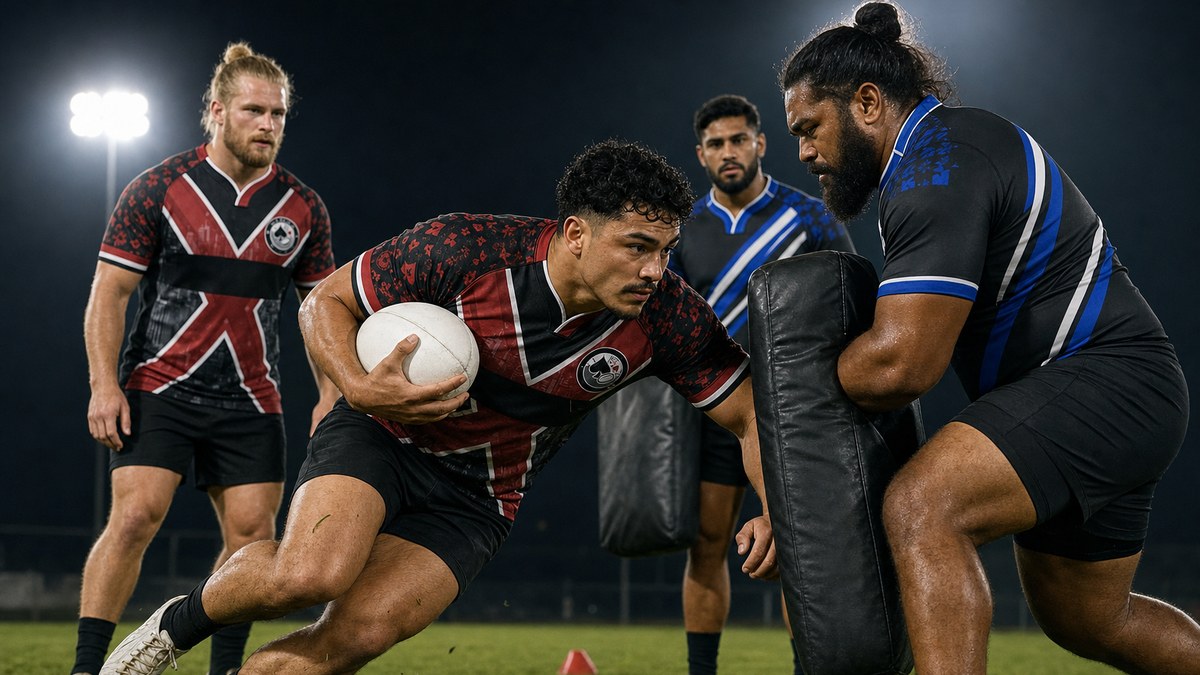
Ball-Carrying Drills: Solo, Partner and Team
The drills below build from no contact to controlled contact with shields and then to small games. As Rugby Ready suggests, focus on one or two key points at a time, and build sessions that reward evasion as well as contact. Anything with contact should be supervised by a qualified coach.
Solo drills (no partner, no contact)
1. Two-hand carry and footwork runs. Set five cones in a zig-zag about 3 m apart. Run through with the ball in two hands, chop your feet before each cone and step off one foot to the side, as if forcing a defender to turn. Reps: 6 runs, walk back recovery. Progression: on the last cone, drop your hips, bring the ball tight to your chest and take five short, powerful steps.
2. Height-change runs. Jog 10 m tall with the ball in two hands, then over the next 2 m drop into your carry position (hips down, back straight, chest up, eyes forward) and drive for five short steps. Reps: 8. Coaching point: film yourself from the side once: your head should stay up while your hips drop.
3. Get-down, get-up placement. From a walk, go to ground safely (backside, then shoulder), turn toward an imaginary teammate and place the ball long behind you, then get straight back to your feet. Reps: 10, alternating sides. Do this on soft grass. It is the link between this week and next week's ball placement episode.
Partner drills (coach supervised)
4. Resisted running (Rugby Coach Weekly). On firm ground in pairs, over 3 m. One player resists while the other drives forward with small, fast steps, back straight and head up. Do five drives, then rest and swap. Progression: hold a ball in two hands while you drive.
5. Extended pad drive (Rugby Coach Weekly). Start 1 m from a partner holding a ruck pad or tackle shield. Explode forward, make contact with the shoulder and drive the pad back for six steps. Four reps, then swap. Rugby Coach Weekly suggests doing these at the start of training or at the end of the warm-up.
6. Power step onto a shield. From 5 m, the carrier jogs at the shield holder with the ball in two hands, takes small steps, drops the hips, moves the ball into the arm away from contact and drives through the shield, finishing with the trailing leg. Reps: 6 each side. Progression: the holder shuffles slightly left or right at the last moment so the carrier has to adjust footwork.
7. Shield hit and pop. As in episode 3: the carrier drives into a shield, keeps the legs going, and pops the ball to a support runner arriving from behind. This trains the habit of looking to pass out of contact first.
Small-group and team drills (coach supervised)
8. Leg drive in fours (Sportplan). Groups of four: two pad holders, one worker, one resting. The worker drives into the pads for 45 seconds, then rotate. Cues: "keep back straight", "hit square" and "drive legs (short fast steps)". Sportplan notes it can also be done without pads.
9. Win the Last Yards (Rugby Coach Weekly). One ball per group of four, in a channel about 5 m wide by the touchline. Two defenders start lying on their fronts side by side, facing a ball carrier who is also on their front, with a support player directly behind the carrier. On the call, everyone gets up; the carrier and support try to get the ball over a line 5 m away while the two defenders try to stop them. Stop if the carrier goes to ground or loses the ball. Coaching points: hips square so you always drive forward, fight to stay on your feet, keep the ball available, and both sides keep to the tackle laws. Developments: add a defender, increase the starting distances, or play 2v2 in a 5 m by 10 m box.
10. Carry and present. In a 10 m by 10 m grid, a carrier runs into a shield holder, drives the legs, goes to ground safely, turns and presents the ball for a scrum-half who passes to the next carrier. Reps: 3 sets of 2 minutes. Coaching point: count how quickly the ball comes back: your target is "available at once", as Law 14.7 requires.
A Simple 3-Week Ball-Carry Practice Plan
Here is a plan you can slot into your club's training twice a week, about 20 minutes per session, or do the solo parts at home. This is our suggested structure, not an official programme; your coach should adapt it to your level.
| Week | Session A (about 20 min) | Session B (about 20 min) | Goal |
|---|---|---|---|
| Week 1 | Two-hand carry and footwork runs (6) · height-change runs (8) · get-down, get-up placement (10) | Resisted running in pairs (5 drives × 3) · extended pad drive (4 each) | Body position: hips down, eyes up, small steps |
| Week 2 | Height-change runs (6) · power step onto a shield (6 each side) · shield hit and pop (8) | Leg drive in fours (45 s × 4 rotations) · carry and present (3 × 2 min) | Ball security and finishing the carry |
| Week 3 | Power step with moving holder (6 each side) · shield hit and pop (8) | Win the Last Yards (6 rounds) · 2v2 in a 5 m × 10 m box (4 rounds) | Leg drive under pressure, decisions, quick ball |
Pair this plan with the conditioning work in our 8-week rugby training plan for 10s. Leg drive needs strong legs and repeated effort, especially in the second half of a game.
Ball Carrying in 10s Rugby and at the APR Games
The APR Games 2027 is played as 10s rugby: 10 players a side, typically five forwards and five backs, with two 20-minute halves. That shapes how you carry. With fewer defenders on the pitch than in 15s, there is more space, so the first job of a 10s carrier is still to find a gap or a shoulder. But when contact comes, you have fewer teammates nearby to clean out, which makes the two things in this guide even more valuable: winning the extra meters with leg drive, and getting the ball back to your team quickly. In our view, the 10s carrier who can stay on their feet for one more step, or pop the ball out of contact, is worth their weight in gold.
Every position in 10s carries the ball. Props and locks carry close to the ruck, back-rows and centers carry in midfield, and wings finish in contact near the line. That's why ball carrying is a skill for everyone, not just forwards.
The APR Games runs over Memorial Day weekend, May 29–31, 2027, in Las Vegas, with evening games under the floodlights. The divisions are Men's Elite, Women's Social and Youth, with $15,000 in prize money. The five founding franchises include the Vegas Blackjacks, who describe themselves as "Physical · Intense · Passionate" and as Las Vegas's oldest sports club, founded in 1976 (vegasblackjacksrugbyclub.com), and the Vegas Lions (vegaslionsrugby.com), alongside the Vegas Kings, the Vegas Knights, Downtown Rugby and a mystery invitational team. Meet them all on the teams page.
Win the hard yards in Vegas.
The APR Coaching Clinic runs May 27–29, 2027 in Las Vegas. Then put your carry to work at the APR Games over Memorial Day weekend. Player entry is $299 and includes your official APR Games team jersey, full kit bag, a minimum of three guaranteed pool games, opening-night access and a player profile on americanprorugby.com.

Safety First: Learn Contact Under a Qualified Coach
Carrying into contact is a contact skill. Please read this section even if you skip everything else.
- Learn it at a club, from a qualified coach. In the United States, USA Rugby requires every coach of tackle rugby to hold World Rugby Level 1 (since September 1, 2023), and every coach and referee to complete Rugby's Safety Basics: World Rugby's Rugby Ready plus the Concussion Management for the General Public course. A club with qualified coaches is the right place to learn contact.
- Take the free courses yourself. World Rugby's Rugby Ready: Open field play and Tackle Ready on World Rugby Passport explain safe contact for both carrier and tackler.
- Build up gradually. Start with no-contact footwork and body position, then shields and pads, then controlled small games. Don't jump straight to full-speed live contact.
- Head up, always. Never lead with your head, never drop your head into contact, and never fend into an opponent's head or neck.
- Know the signs of concussion. If a player has a suspected concussion, they stop playing and training. "Recognise and remove" is the rule. Follow your club's and union's return-to-play protocol.
- Train on a safe surface with matched sizes and abilities where possible, and use the warm-up before contact work.
This guide explains technique and practice; it is not a substitute for coaching. If you're new to rugby in or near Las Vegas, our guide to how to start playing rugby as an adult in Las Vegas is a good place to begin.
Tuesday Skills is brought to you by Clann13, an official APR partner that makes supplements for athletes. Thanks to Clann13 for backing a free weekly skills series for American rugby players.
The APR Games is made possible by our partners. Players and fans can support the people who support the game.
Coming to Las Vegas for the Coaching Clinic or the Games? Luna Appleton has guides to where to stay and eat. Running a club? American LED Signage does club and venue signage, Vibe Coding covers tech and apps, and In Too Win works on Las Vegas business and investment. WXE is our energy partner, and Giftabiz lets friends and family back a new business launch.
Frequently Asked Questions
How do you carry the ball into contact in rugby?
Run at space first, carry the ball in two hands, shorten your steps, drop your hips just before contact while keeping your head up and back straight, bring the ball tight to your chest with elbows in, keep driving your legs, and then pass, place or present the ball. Practice the contact parts under a qualified coach.
What is leg drive in rugby?
Leg drive means keeping your feet moving with short, fast, powerful steps through and after contact, so you keep going forward instead of stopping when you are hit. World Rugby's key factors say a tackled carrier should drive their legs to maintain forward movement.
Should I carry the ball in one hand or two?
Two hands in open play, as World Rugby recommends, so you can still pass and the ball is harder to knock loose. As contact arrives, bring it tight to your chest with your elbows in. Some coaches teach moving the ball to the arm away from contact for a power step.
How low should I get when carrying into contact?
Low enough to be stronger than the tackler, but get there by bending your knees and hips, not your neck. Keep your back straight, your chest up and your eyes looking forward. Drop your height just before contact, not several meters out, and never lead with your head.
What should I do when I am tackled to the ground?
Land on your backside and then your shoulder, not on your hands or the ball, turn toward your own team and make the ball available at once by placing, passing or releasing it. Law 14.7 says the tackled player must make the ball available immediately and may place it in any direction.
Is it a tackle if I am held but still on my feet?
No. Under Law 14, a tackle needs the ball carrier to be held and brought to ground, meaning lying, sitting or with at least one knee on the ground. If you are held but still standing, keep driving your legs or look to offload to a teammate.
Can I practice ball carrying on my own?
Yes, the non-contact parts: two-hand carrying, footwork runs, height changes and safe get-down, get-up placement. Shield work, resisted drives and live contact should be done with a partner at a club under a qualified coach.
Is fending (a hand-off) allowed?
A legal hand-off is part of rugby, but it must be done safely and never into the head or neck. Research on elite tackles by Tierney and colleagues found that fending into front-on contact was linked to head injury assessments for tacklers, so coaches are urged to teach safe fending.
Is there coaching at the APR Games?
Yes. The APR Coaching Clinic runs May 27 to 29, 2027 in Las Vegas, alongside the APR Games on Memorial Day weekend, May 29 to 31. Register at americanprorugby.com for updates.
Are the players in the images real?
No. The images are illustrations of fictional players wearing the kits of two APR teams, the Vegas Blackjacks and the Vegas Lions. They do not show a real match, real players or a real result.
Keep Reading
Next Tuesday: Tuesday Skills #6 — ball placement after the tackle. Follow @americanprorugby or sign up to the APR newsletter so you don't miss it. New to the tournament? Start with our APR Games 2027 guide, see how to build a 10s rugby team, or check what to pack for a rugby tournament. Want the gear? Visit the APR merch store, browse the latest rugby news, or contact us.
Sources
- World Rugby Passport: Key factor analysis — Tackling and contact (ball carrier, contact with ground)
- World Rugby Passport: Key factor analysis — Passing out of the tackle
- World Rugby Passport: Rugby Ready — Open field play
- World Rugby Laws: Law 14 — Tackle
- World Rugby Passport: Rugby Ready — The tackle
- World Rugby: Tackle Ready launch (2021)
- World Rugby: Community tackle height law wordings approved (2026)
- Rugby Coach Weekly: Power step into contact
- Rugby Coach Weekly: Technique for driving the legs in rugby contact
- Rugby Coach Weekly: Win the last yards
- Sportplan: Rugby leg drive drills
- Tierney, Denvir, Farrell & Simms, Journal of Sports Sciences (2019): Does ball carrier technique influence tackler head injury assessment risk in elite rugby union?
- USA Rugby: Coaching training and education
This guide is for general education and is based on the coaching and laws sources above. It is not a substitute for in-person coaching. Carrying into contact carries a risk of injury: learn and practice contact only under a qualified coach, and follow your union's and competition's rules. APR Games competition rules will be confirmed ahead of the tournament. Images are illustrations of fictional players, not real matches or results. Questions? Contact us.