Rugby Offside Rules Explained: Open Play, Rucks, Mauls, Scrums and Lineouts
Offside is the law that decides where every player is allowed to stand, and it causes more confusion than anything else in rugby union. Here is a plain-English guide to every offside line, built on World Rugby's own law wording, with what it means for 10s rugby and the APR Games 2027 in Las Vegas.
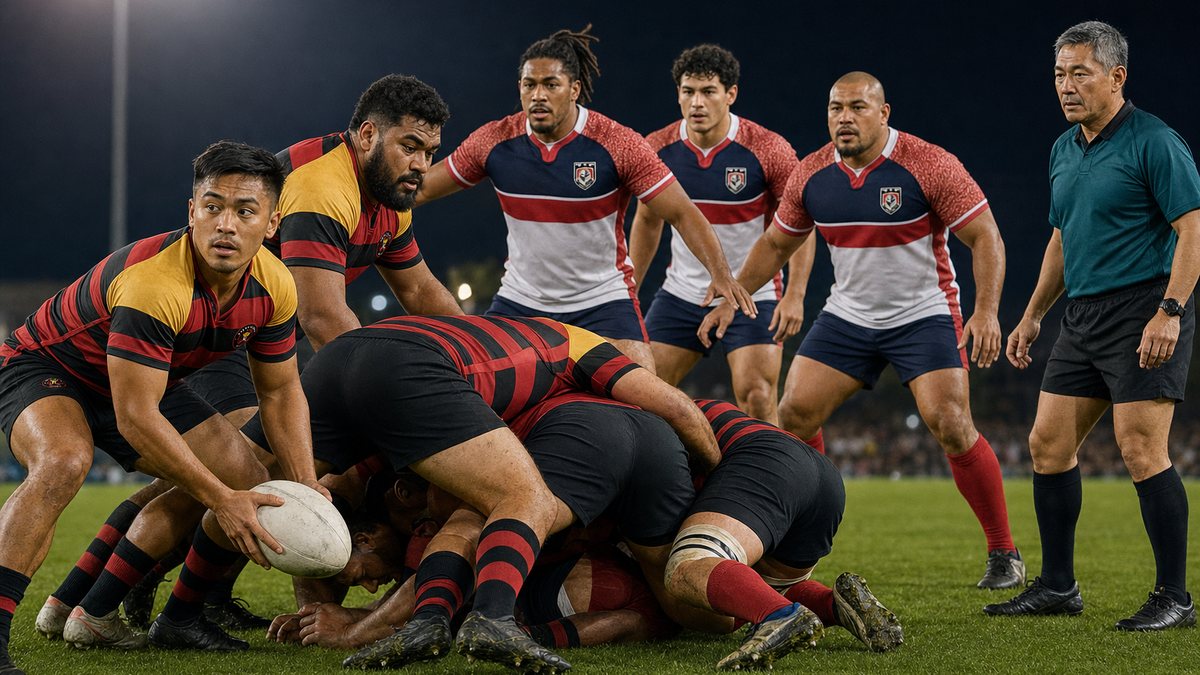
Rugby offside rules tell every player on the field where they are allowed to be. Unlike soccer, where offside is mostly about one attacker and the last defender, rugby has an offside line at almost every moment of the game: in open play, at every tackle, ruck and maul, at every scrum and lineout, and every time someone kicks the ball. Get them right and your team defends with confidence. Get them wrong and you hand the other side penalties, field position and points.
This guide walks through the offside laws of rugby union as World Rugby publishes them in November 2026. Where precision matters we quote the law book directly, with clause numbers, so you can check it yourself. We also explain what changes (and what does not) in 10s rugby, the format of the APR Games 2027 on Memorial Day Weekend, May 29–31, 2027, in Las Vegas. If you are brand new to the sport, our explainer on what 10s rugby is is a good place to start.
- Being offside is not an offence by itself. You are only penalised if you take part in play, move toward the ball or fail to get back onside.
- Open play: you are offside if you are in front of a team-mate who is carrying the ball or who last played it.
- Tackle, ruck and maul: the offside line runs through the hindmost foot (or hindmost point) of your team's players in it.
- Scrum: players not in the scrum must stay at least five meters behind their team's hindmost foot.
- Lineout: players not in the lineout must stay at least 10 meters back from the mark of touch.
- Kicks: under the 10-metre law, players in front of their kicker must retreat 10 meters from where the ball lands.
What Offside Means in Rugby
World Rugby's definitions describe offside as "a positional offence meaning a player can take no part in the game without being liable to sanction." The key word is positional. You can find yourself in an offside position through no fault of your own, for example when a team-mate breaks past you or kicks the ball over your head. That alone is fine.
World Rugby's beginner's guide puts it simply: "Being in an offside position is not, in itself, an offence, but an offside player may not take part in the game until they are onside again." It adds that "if an offside player takes part in the game, that player will be penalised." The purpose, in World Rugby's words, is to restrict "where on the field players can be, to ensure there is space to attack and defend."
That idea of space is the heart of it. Rugby allows only backward passes, so the attacking team needs room in front of the ball to run into. Offside lines guarantee that room by keeping defenders behind a fixed line until the ball comes out. Without them, defenders could stand among the attackers and smother every phase.
APR's view: if you remember one thing, remember that every offside line is about the ball and the last point of contact. In open play it is the ball. At a tackle, ruck or maul it is the back foot of your own players in it. At a scrum it is five meters behind that back foot. At a lineout it is 10 meters back from the line of touch. Everything else is detail.
Offside in Open Play (Law 10)
Open play is the running, passing and kicking between set pieces and breakdowns. Law 10.1 says: "A player is offside in open play if that player is in front of a team-mate who is carrying the ball or who last played it." For kicks, "the foot kicking the ball determines the offside line." Law 10.2 adds that "a player can be offside anywhere in the playing area," so there is no safe zone, not even in your own half.
The law then tells an offside player what they must not do. Law 10.1 states that "an offside player must not interfere with play," and lists the ways a player interferes: playing the ball, tackling the ball-carrier, preventing the opposition from playing as they wish, or loitering in an offside position. Loitering is defined as a player who "remains in an offside position," and the definitions add that "a loiterer must not benefit from being put onside by the opposing team's action."
One small exception is worth knowing. Law 10.3: "A player who receives an unintentional throw forward is not offside." The forward pass itself is still an offence, but the receiver is not punished twice.
When an offside player is penalised
Under Law 10.4, an offside player may be penalised if that player does not make an effort to retreat and interferes with play, moves toward the ball, or breaks the 10-metre law (more on that below). For those offences the non-offending team can choose either a penalty at the place of the infringement or a scrum where the offending team last played the ball.
How you get back onside
Law 10 gives three routes back onside. You can fix it yourself, a team-mate can fix it for you, or, in some cases, the opposition can fix it for you.
| Route | What the law says | In practice |
|---|---|---|
| Your own action (10.6) | You are put onside when you move behind a team-mate who last played the ball, or behind a team-mate who is onside. | Turn and run back past the ball, or behind a team-mate who is level with or behind it. |
| A team-mate (10.7a) | "An onside team-mate of that player moves past the offside player and is within or has re-entered the playing area." | Your kicker or a chaser who started behind the ball runs past you. |
| An opponent (10.7b) | An opponent kicks the ball, or "intentionally touches the ball without gaining possession of it." | The defender clears the kick, or deliberately tips the ball without catching it. |
| Ball into touch (10.7c) | "The ball has gone into touch, providing the player was complying with law until that point." | Play stops for a lineout and everyone resets. |
There is one big exception to the opponent route, and it involves kicks. That is where the most famous offside law in rugby comes in.
Accidental offside
Sometimes a player simply cannot get out of the way. Law 10.5 says "a player is accidentally offside if the player cannot avoid being touched by the ball" (it also covers being touched by a team-mate who is carrying it). Accidental offside is treated much more lightly than deliberate interference: "Only if the offending team gains an advantage should play stop," and the sanction is a scrum, not a penalty.
The 10-Metre Law: Offside at Kicks
When your team kicks the ball, every player in front of the kicker is offside. Law 10.4(c) says such a player may be penalised if they were "in front of a team-mate who kicked the ball and fails to retire immediately behind an onside team-mate or an imaginary line across the field 10 metres on that player's side from where the ball is caught or lands." The law book adds: "This is known as the 10-metre law."
Three details make the 10-metre law different from ordinary open-play offside:
- The opponent cannot put you onside. Law 10.8: "A player offside under Law 10.4c cannot be put onside by any action of an opponent, apart from a charge down." Even if the catcher runs five meters or passes, you must still get back or be put onside by your own team.
- Charge-downs switch it off. The 10-metre law "does not apply when the kick is charged down, or is touched in an attempted charge down."
- The closest player pays. When several players are involved, "the player closest to where the ball lands or is caught is the one penalised."
For chasers, the practical rule is simple: if you are in front of your kicker, stop, turn and walk back toward your own goal line until the kicker or another onside team-mate passes you. Do not drift toward the catcher. The kick chase that matters comes from the players who started level with or behind the kicker.

Offside at the Tackle (Law 14)
A tackle on its own does not create offside lines. Law 14.10 says: "Offside lines are created at a tackle when at least one player is on their feet and over the ball, which is on the ground." Once that happens, "each team's offside line runs parallel to the try line through the hindmost point of any player in the tackle or on their feet over the ball."
Other players arriving at the tackle must "arrive at the tackle from the direction of their own try line before playing the ball" (14.8c) and "remain on or behind their offside line" (14.8f). Both carry a penalty. This is what coaches and commentators mean when they talk about "coming through the gate", although that phrase is not in the law text itself. You cannot run around the side of the tackle and play the ball from the opponents' side.
For the full picture of what the ball-carrier, tackler and arriving players must each do at the tackle, see our Tuesday Skills episodes on safe tackle technique and placing the ball after the tackle.
Offside at the Ruck (Law 15)
A ruck forms when players from both teams are on their feet, in contact, over the ball on the ground. Law 15.4: "Each team has an offside line that runs parallel to the try line through the hindmost point of any ruck participant. If that point is on or behind the try line, the offside line for that team is the try line."
The ruck laws then set out how players join or stay out:
- "An arriving player must be on their feet and join from behind their offside line" (15.5).
- "A player may join alongside but not in front of the hindmost player" (15.6).
- "Players must join the ruck or retire behind their offside line immediately" (15.8).
- Players who have already been in the ruck may rejoin it, "provided they do so from an onside position" (15.9).
All of these are penalty offences. This is the offside that decides most games at every level, because rucks happen dozens of times per half. A defender who creeps a step past the back foot of the ruck to put pressure on the scrum-half is offside, and good referees watch for it constantly.
The ruck offside line also explains why defensive line speed has limits. In our guide to rugby defense systems, the blitz defense works because the whole line leaves together the moment the ball is out, not a moment before. Leave early and the fastest defense in the world is just a penalty waiting to happen.
Offside at the Maul (Law 16)
The maul works the same way, but it is all about feet. Law 16.4: "Each team has an offside line that runs parallel to the try line through the maul participants' hindmost foot that is nearest to that team's try line." As with the ruck, the try line becomes the offside line if that foot is on or behind it.
Law 16.5 says a player "must either join a maul from an onside position or retire behind their offside line immediately," and 16.6 adds that "players who leave a maul must immediately retire behind the offside line." When joining, a player must do so from an onside position and bind on to the hindmost player in the maul (both penalty offences), with heads and shoulders no lower than their hips (a free kick).
Mauls are less common in open 10s play than in 15s, but they appear off lineouts and they win games. The USA Eagles' winning try against Hong Kong China in November came from a lineout maul, as we covered in our Nations Cup round 4 analysis. Defending a maul legally starts with knowing exactly where your offside line is.
Know the lines. Play the tournament.
The APR Games is a 10s rugby tournament on Memorial Day Weekend in Las Vegas: two 20-minute halves, evening kickoffs under floodlights and $15,000 in prize money. Player entry is $299 and includes an official team jersey, a full kit bag, at least three guaranteed pool games, opening-night access and a player profile. Player registration is open now. Coaches can also book the three-day Coaching Clinic, Thursday–Saturday, May 27–29, 2027.
Offside at the Scrum (Law 19)
The scrum has the most offside lines of any phase, because it sets different rules for the forwards in it, the two scrum-halves and everyone else.
Everyone not in the scrum
Law 19.31 is the one most players need: "All players not participating at the scrum remain at least five metres behind the hindmost foot of their team." Near the try line, Law 19.32 makes the try line the offside line "when the hindmost foot of a team is in in-goal or within five metres of that team's try line." Both are penalty offences. Law 19.27 adds that "players remain onside for the duration of the scrum."
The scrum-halves
Before the ball goes in, the scrum-half of the team not throwing in stands either next to the opposing scrum-half on their own side of the middle line, or "at least five metres behind the hindmost foot of their team's last player in the scrum" and stays there until the scrum is over (19.28). Once play starts, the scrum-half whose team has the ball must keep at least one foot level with or behind the ball (19.29).
The defending scrum-half's options after the ball goes in are in Law 19.30, which the law book currently labels as a global law trial: stay near the scrum with both feet no further than the centre line of the tunnel, retire to the offside line at their team's hindmost foot, or retire at least five meters behind the hindmost foot. Because it is trial wording, check your competition's rules.
When the scrum ends
Law 19.33: "As soon as the scrum ends, offside lines no longer apply." From that moment, open-play offside under Law 10 takes over.
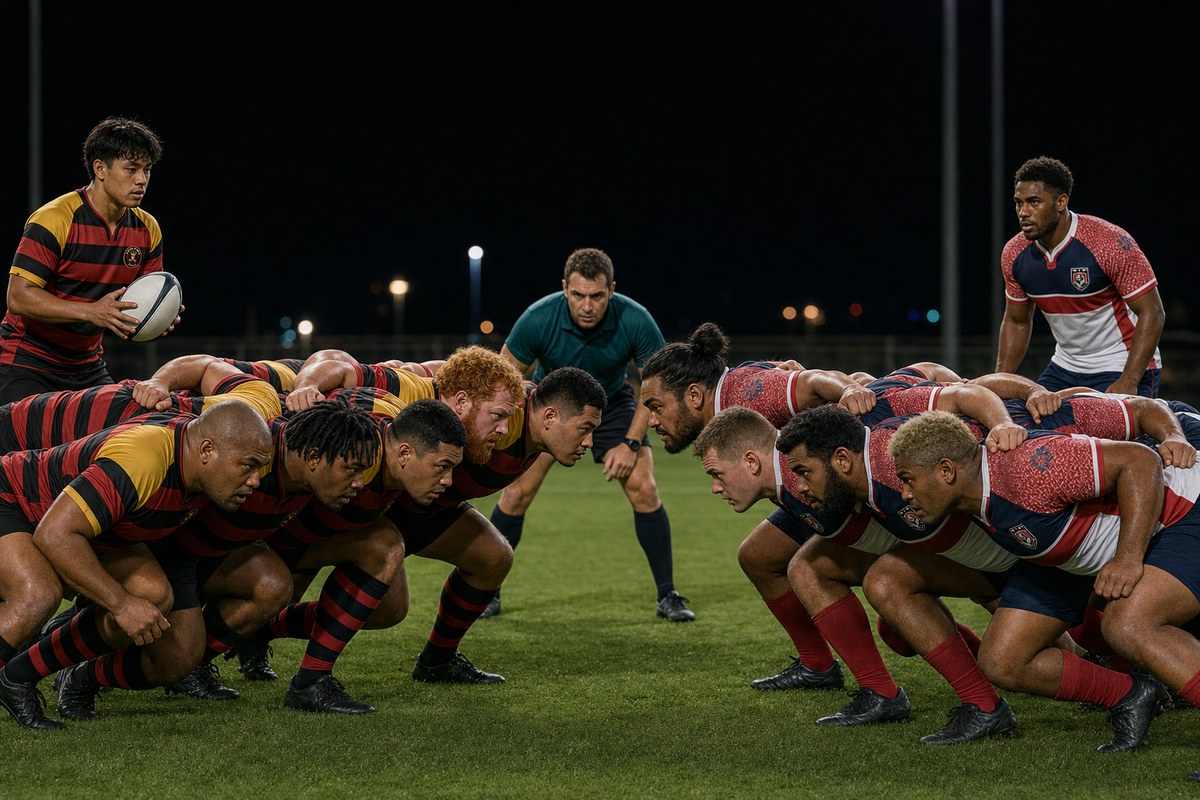
What changes in a 10s scrum
World Rugby's 10s variation replaces Law 19.5 with: "A scrum must have five players in two rows from each team" (two props and a hooker, then two locks), and all five "must stay bound to the scrum until it ends and may not unbind to play the ball." The variation also removes the number-eight clause from the list of ways a scrum ends, so in 10s the scrum ends when the ball is played by the scrum-half. The 10s variation pages we checked list no change to the scrum offside lines themselves, so the five-meter rule for non-participants still applies. With only five backs behind a 10s scrum, that five-meter gap creates a lot of space to attack, which is one reason 10s scrums are such valuable attacking platforms.
Offside at the Lineout (Law 18)
The lineout splits players into participants (the players in the line, one receiver from each team if present, the thrower and the thrower's immediate opponent) and everyone else.
- Lineout players: "All lineout players are onside if they remain on their side of the mark of touch until the ball has been thrown in and touched a player or the ground" (18.30). After that, "their offside line is a line through the ball" (18.32).
- Jumpers: players who cross the mark of touch and do not catch the ball "must immediately return to their own side" (18.31).
- A ruck or maul at the lineout: participants may join it, or retire to "the hindmost foot of that player's team in the ruck or maul" (18.33).
- Everyone else: "Players not participating in the lineout must remain at least 10 metres from the mark of touch on their own team's side or behind the try line if this is nearer" (18.35).
The lineout ends when the ball or the ball-carrier leaves the lineout, enters the area between the touchline and the five-meter line, or goes beyond the 15-meter line; when a ruck or maul forms and all the players' feet move beyond the mark of touch; or when the ball becomes unplayable (18.38). Until then, the backs must hold their 10-meter line. We did not find a 10s-specific lineout variation in World Rugby's 10s pages; APR's full tournament rules will be confirmed ahead of the tournament.
Still Offside After the Set Piece: Retiring Properly
This is the part of the law that catches out experienced players. Law 10.9: "A player who is offside at a ruck, maul, scrum or lineout remains offside even after the ruck, maul, scrum or lineout has ended." The phase ending does not wipe the slate clean.
Under Law 10.10, that player can be put onside only if they immediately retire behind the applicable offside line, if "an opposition player carries the ball five metres in any direction," or if an opposition player kicks the ball. Under Law 10.11, the player can be penalised for failing to retire without undue delay and benefiting from it, for interfering with play, or for moving toward the ball. All three are penalties.
In practice: if you were caught on the wrong side of a ruck, do not wait for the ball to come out and then join the defensive line from where you are. Get back onside first, immediately, and then rejoin the defense.
Penalty, Free Kick or Scrum? The Offside Sanctions
Most offside offences are penalties, but not all. This table summarizes the main offside situations and what the law book says happens.
| Situation | Offside line | Sanction |
|---|---|---|
| Open play (10.4a, b) | The ball, or the team-mate who last played it | Penalty, or a scrum where the offending team last played the ball (non-offending team chooses) |
| Kick, 10-metre law (10.4c) | 10 meters from where the ball lands or is caught | Penalty, or scrum option |
| Accidental offside (10.5) | N/A | Scrum, and only if the offending team gains an advantage |
| Tackle (14.8f) | Hindmost point of players in the tackle or on their feet over the ball | Penalty |
| Ruck (15.5–15.9) | Hindmost point of any ruck participant | Penalty |
| Maul (16.5–16.7) | Hindmost foot of the team's maul participants | Penalty (free kick for joining with head and shoulders below hips) |
| Scrum (19.31, 19.32) | Five meters behind the team's hindmost foot, or the try line | Penalty |
| Lineout non-participants (18.35, 18.36) | 10 meters from the mark of touch, or the try line | Penalty |
| Failing to retire after a phase (10.11) | The applicable offside line | Penalty |
Because offside is usually a penalty, it is expensive. A penalty lets the other team kick at goal for three points, kick to touch and throw in, or tap and run. Repeated offside offences near your own line are also a common route to a yellow card for persistent infringing. Our guide to rugby yellow and red cards explains how sin bins work, including the two-minute suspension used in World Rugby's 10s variation. And if you want to read the referee's arm when it happens, our referee signals guide shows the penalty, free kick and scrum signals.
Why Offside Matters Even More in 10s Rugby
10s rugby is played with 10 players a side, typically five forwards and five backs, on a full-size field. At the APR Games, games are two 20-minute halves. Fewer players across the same width means more space everywhere, and offside lines decide who gets to use that space.
APR's view: three offside habits separate good 10s teams from the rest.
- Ruck discipline in defense. With fewer defenders, the temptation is to shoot up early to close space. Do that and you give away a penalty. The teams that defend well in 10s set quickly behind the hindmost foot, then go together.
- Kick-chase discipline. Kicks are a big part of 10s because there is so much grass behind the defense. Every player in front of the kicker must respect the 10-metre law. A chaser who waits for the catcher to run five meters is still offside under 10.4(c); only an onside team-mate or a charge-down puts them back.
- Scrum and lineout spacing as an attacking weapon. In 10s, the five-meter scrum gap and the 10-meter lineout gap matter even more because there are only five backs to fill the width. Attacking teams can plan first-phase moves around that space.
Fitness is part of it too. Offside penalties tend to rise when tired players stop running back. Our 8-week rugby training plan for 10s is built around the repeated efforts it takes to get back onside again and again in the last minutes of a half.
How Coaches Can Build Offside Discipline
Offside is a team habit, not a single skill, so it is best coached through systems, language and game-like training. Here are approaches APR coaches find useful. They are general coaching ideas, not a replacement for World Rugby or USA Rugby coaching courses.
- Name the line. Give your team one word for "the hindmost foot" (many teams just shout "back foot") so the whole line resets to the same point after every ruck.
- Referee your own training. Put a coach or a player in a bib with a whistle during opposed sessions and penalize every offside. Players learn faster when it costs them.
- Train the walk-back. After every kick in training, the players in front of the kicker turn and walk back until passed. It sounds basic, but it removes the most common kick-chase penalty.
- Review on film. Pause match video at the moment the ball leaves a ruck and check every defender's feet against the back foot. It is the quickest way to see who drifts.
- Get qualified. USA Rugby requires coaches to complete its safety and coaching requirements; see USA Rugby's coaching page for the current pathway, and World Rugby's law resources on World Rugby Passport.
The APR Coaching Clinic, Thursday–Saturday, May 27–29, 2027, in Las Vegas, is three days of coaching during tournament week. See the Coaching Clinic for details and booking. Players building toward a long tournament weekend can also look at what our partner Clann13, an APR partner that makes supplements for athletes, offers on its site.
Five Offside Myths, Busted
| Myth | What the law actually says |
|---|---|
| "Being offside is a penalty." | No. Being in an offside position is not an offence. You are penalised only if you interfere, move toward the ball or fail to retire. |
| "You can't be offside in your own half." | Law 10.2: "A player can be offside anywhere in the playing area." |
| "Once the catcher runs five meters, kick chasers are onside." | Not under the 10-metre law. Law 10.8 says only a charge-down by an opponent can put them onside; otherwise they need an onside team-mate to pass them or must retire. |
| "When the ruck ends, everyone is onside." | Law 10.9: a player offside at a ruck, maul, scrum or lineout "remains offside" after it ends until put onside. |
| "Offside lines are the same in 10s as in 15s, so 10s has no changes at all." | The offside lines we checked are the same, but the 10s scrum has five players a side and a different end point, and other 10s variations (match length, sin bin, restarts) apply. |
Watching for Offside at the APR Games
Once you know the lines, you can watch a game the way referees do. At every ruck, look at the defenders' feet, not the ball. At every kick, look at who is in front of the kicker and whether they turn back. At every scrum, watch the backs hold their five meters. You will start predicting penalties before the whistle goes.
The APR Games runs Saturday to Monday, May 29–31, 2027, with evening kickoffs under floodlights, so there is plenty of time to enjoy Las Vegas around the games. Our partner Luna Appleton has guides to where to stay, eat and celebrate in Vegas. Running a club and want your sign to be seen? American LED Signage designs and installs commercial LED signs for venues and businesses.
The APR Games is made possible by our partners. Players and fans can support the people who support American rugby:
Clann13, an APR partner that makes supplements for athletes, also presents our weekly Tuesday Skills series. Want to build a simple app that logs your team's penalties by type? Learn the basics of AI-assisted coding at Vibe Coding.
Frequently Asked Questions
What is offside in rugby, in simple terms?
A player is in an offside position when they are in front of the place the law says they must stay behind: in open play, in front of the team-mate carrying or last playing the ball; at a ruck or maul, past their team's hindmost foot; at a scrum, closer than five meters behind it; at a lineout, closer than 10 meters to the mark of touch. Being there is not an offence, but taking part in play from there is.
Is being offside always a penalty?
No. World Rugby says being in an offside position is not an offence in itself. A player is penalised if they interfere with play, move toward the ball, break the 10-metre law or fail to retire. Accidental offside, when a player cannot avoid being touched by the ball, is a scrum, and only if the offending team gains an advantage.
What is the 10-metre law in rugby?
When a team-mate kicks the ball, any player in front of the kicker must immediately retire behind an onside team-mate or an imaginary line 10 meters from where the ball lands or is caught. Only an onside team-mate or a charge-down can put them onside; the opponent catching and running does not.
Where is the offside line at a ruck?
Law 15.4 says each team's offside line runs parallel to the try line through the hindmost point of any ruck participant on that team's side. If that point is on or behind the try line, the try line is the offside line. Players must join from behind it or retire behind it immediately.
How far back do players stand at a scrum?
Players not participating in the scrum must stay at least five meters behind their team's hindmost foot. If that foot is in in-goal or within five meters of their own try line, the try line is their offside line. Scrum-halves have their own positions under Law 19.28 to 19.30.
How far back do players stand at a lineout?
Players not participating in the lineout must remain at least 10 meters from the mark of touch on their own team's side, or behind their try line if that is nearer. They stay there until the lineout ends, for example when the ball goes beyond the 15-meter line.
How does an offside player get back onside?
By moving behind the team-mate who last played the ball or behind an onside team-mate; by an onside team-mate running past them; by an opponent kicking the ball or intentionally touching it without gaining possession; or by the ball going into touch. After a ruck, maul, scrum or lineout, an opponent carrying the ball five meters or kicking it also works.
What is "coming through the gate"?
It is a common coaching phrase, not law wording. It describes Law 14.8, which says players arriving at a tackle must come from the direction of their own try line and stay on or behind their offside line, rather than playing the ball from the side.
Are the offside rules different in 10s rugby?
The offside lines in World Rugby's 10s variation pages we checked are the same as in 15s. The 10s variation does change the scrum (five players a side in two rows), match length, the sin bin and some restart sanctions. APR Games rules will be confirmed ahead of the tournament.
Are the players in the images real?
No. The images are illustrations of fictional players wearing the kits of two APR founding franchises, the Vegas Kings and the Vegas Knights. They do not show a real match or result.
Keep Reading
More from the Tuesday Skills series: carrying the ball into contact, the pop pass, catching and the spin pass. New to the laws? Read how long a rugby game lasts and 10s rugby positions explained.
Want more? Sign up to the APR newsletter for updates, catch up on the latest rugby news, see the divisions on the APR Games page, register for the APR Games, or kit yourself out at the APR merch store. Meet the two franchises in this article's images: the Vegas Kings and Vegas Knights, plus the Vegas Blackjacks, Downtown Rugby and Vegas Lions in the teams section. Building a squad? Read how to build a 10s rugby team or how to start playing rugby as an adult in Las Vegas, or contact us.
Sources
- World Rugby Passport: Law 10 — Offside and onside in open play
- World Rugby Passport: Law 14 — Tackle
- World Rugby Passport: Law 15 — Ruck
- World Rugby Passport: Law 16 — Maul
- World Rugby Passport: Law 18 — Touch, quick throw and lineout
- World Rugby Passport: Law 19 — Scrum
- World Rugby Passport: 10s variation — Law 19 Scrum
- World Rugby Passport: Definitions
- World Rugby: Beginner's Guide — Offside
- USA Rugby: Coaching training and education
This guide is for general education and is current as of November 25, 2026. Law wording is quoted from World Rugby's published Laws of the Game; some clauses are marked as global law trials and may change. Always check the current Laws of the Game and your competition's rules. APR Games rules will be confirmed ahead of the tournament. Images are illustrations of fictional players, not real matches. Questions? Contact us.